Research & Treatment Overview
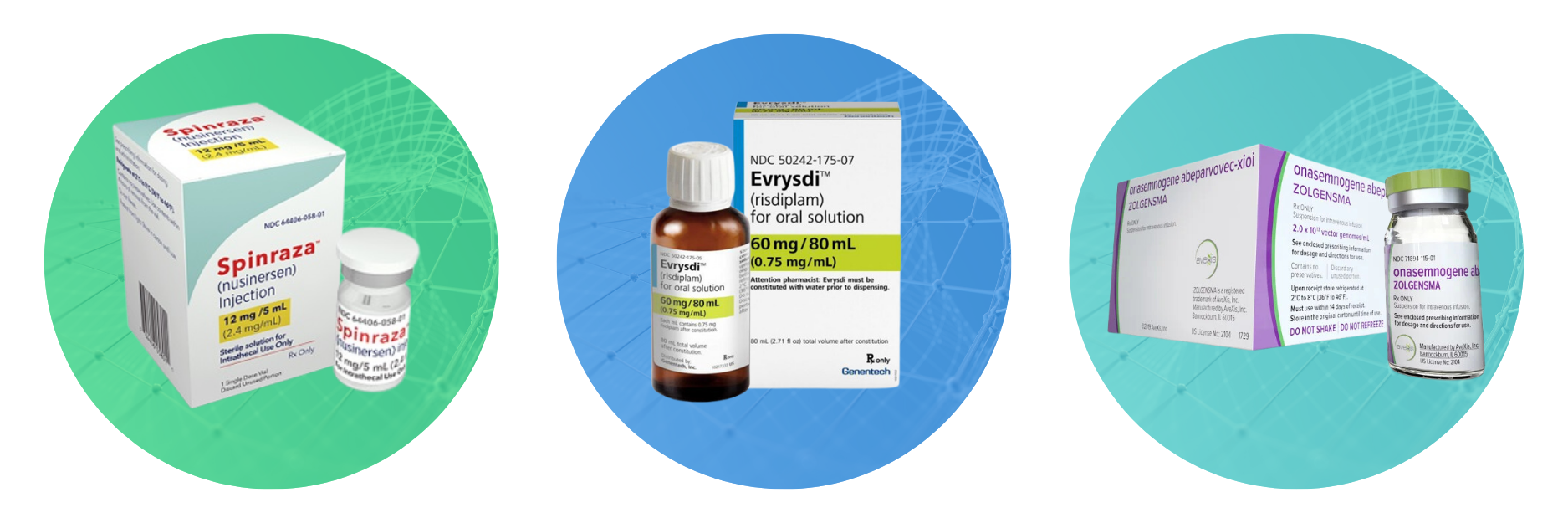
Research & Treatment Overview
Last updated: September 2026
In this section in the tabs below our drug pipeline tracks the progress of SMA treatments currently being tested in human clinical trials. We also describe the science behind the different treatment approaches. You can also watch this great summary recorded in December 2025 with our Scientific Research Correspondent Dr James Sleigh:
In our drug pipeline we track the progress of SMA treatments currently being tested in human clinical trials.
The diagram is split into:
- drugs that increase SMN protein levels (SMN-dependent)
- combined treatments that deliver SMN-dependent with SMN-independent drugs (those that do not affect SMN protein levels)
- SMN-independent treatments that aim to support the neuromuscular system
Download the diagram below to see how each drug is progressing through clinical trials and follow links to further information about each drug. You can also find listings for any related global trial on the ClinicalTrials.gov website. Each listing includes details such as:
- eligibility criteria
- where in the world the trial is taking place
- if the trial is currently recruiting.
The diagram will be regularly updated to map the development and progress of each drug programme.
Download the Drug Pipeline – May 2026 >
Researchers have tested other drugs in clinical trials. As a result they have then found them not suitable for treating SMA:
Drugs No Longer Being Considered for SMA >
SMA is caused by mutation of the SMN1 gene. Researchers think that we may be able to treat SMA by replacing this faulty gene.
A type of treatment known as gene therapy, or gene transfer, is thought to be a viable option for restoring the SMN protein that is lacking in people with SMA. As well as replacing SMN1, gene transfer, targeting other important genes, could also be used to provide additional protection to motor neurons, the main cells affected by SMA.
How Gene Therapy Works
Gene therapy uses short pieces of DNA from genes, for example SMN1 for SMA. As it is not possible to insert the gene directly into a cell, scientists use a carrier called a vector to deliver the gene to the human cells that need it. For human gene therapy, harmless viruses are the vectors used to ‘infect’ the cells with the new DNA. Importantly, the viruses are modified so that they are not contagious and cannot cause disease.
Gene Therapy Challenges
The main cells affected by SMA, the lower motor neurons, are found in the spinal cord. This means vectors have to cross the blood-brain barrier in order to reach these target cells. The blood-brain-barrier is a semi-permeable covering that protects the brain from foreign substances and maintains a constant brain environment. Finding gene transfer techniques that can cross this barrier presents a real challenge.
The SMN2 gene also contributes to the production of SMN protein, though it only makes approximately 10% of that produced by SMN1. For this reason, SMA is caused only by mutations in the SMN1 gene and not SMN2, and also why SMN2 is often called the SMN ‘back-up’ gene.
Anyone who has SMA has at least one copy of the SMN2 gene. Individuals can have multiple copies of SMN2, and, in general, it seems that those with more copies have a less severe form of SMA.
Most of the SMN protein made by SMN2 (about 90%) is missing an important piece called exon 7. The remaining 10% of the protein produced by SMN2 includes exon 7 and is the same as that made by SMN1. A number of treatment strategies that target SMN2 to make more functional SMN protein are being explored; they aim to do this in one of three main ways:
- Correct SMN2 splicing, allowing SMN2 to more efficiently produce functional SMN protein:
- Splicing, Exons and the SMN2 ‘Back-Up’ Gene
- Increase the protein production from SMN2 leading to more functional SMN protein.
- Stabilise the functional SMN protein made by SMN2 and therefore make it last longer.
Nusinersen is not a classical gene therapy because the treatment does not directly modify a person’s genes. However, it is sometimes regarded as a ‘gene therapy’ as it impacts how the messenger RNA from the SMN2 gene is used to make SMN protein.
Antisense oligonucleotides
Antisense oligonucleotide drugs are small snippets of synthetic genetic material that bind ribonucleic acid (RNA). They are often described as molecular patches because they can be specifically designed to target and affect how a particular gene is read. ASOs have great potential for SMA, because they can accurately target the SMN2 gene to essentially convert it into the SMN1 gene, i.e. they are small molecules “patching-up” SMN2 to act more like SMN1. They do this by binding to the RNA template made by SMN2 and enhancing the inclusion of Exon 7 into the SMN protein. (See the above link for a more detailed explanation).
The SMN2 gene also contributes to the production of SMN protein, though it only makes approximately 10% of that produced by SMN1. For this reason, SMA is caused only by mutations in the SMN1 gene and not SMN2, and also why SMN2 is often called the SMN ‘back-up’ gene.
Anyone who has SMA has at least one copy of the SMN2 gene. Individuals can have multiple copies of SMN2, and, in general, it seems that those with more copies have a less severe form of SMA.
Most of the SMN protein made by SMN2 (about 90%) is missing an important piece called exon 7. The remaining 10% of the protein produced by SMN2 includes exon 7 and is the same as that made by SMN1. A number of treatment strategies that target SMN2 to make more functional SMN protein are being explored; they aim to do this in one of three main ways:
- Correct SMN2 splicing, allowing SMN2 to more efficiently produce functional SMN protein.
- Splicing, Exons and the SMN2 ‘Back-Up’ Gene
- Increase the protein production from SMN2 leading to more functional SMN protein.
- Stabilise the functional SMN protein made by SMN2 and therefore make it last longer.
Small molecules
Small molecules are chemicals or compounds that are capable of treating or even curing a disease. These potential drugs may be used to increase the amount of SMN protein made by SMN2.
A multi-step process is used to convert small molecules into drugs:
- Researchers screen hundreds of thousands of chemicals through a process called ‘high-throughput screening’ in their search for a chemical that that might work for SMA, i.e. one that increases SMN protein levels.
- Using medicinal chemistry, scientists then modify the chemical numerous times trying to optimise its structure to make a safe and useable drug.
- These ‘optimised candidate drugs’ are then tested in animal studies for their efficacy and safety before they are trialled on humans.
- Successful optimised candidate drugs are then redefined as an ‘Investigational New Drug’ (IND) and an application is submitted for it to be approved for human clinical trials.
A number of companies and academic laboratories have small molecule programmes that are attempting to identify and develop compounds that target the SMN2 gene.
For an up to date view of progress see:
The lower motor neurons in the spinal cord specifically deteriorate in SMA patients. Messages from the spinal cord can no longer be efficiently passed to their target muscles, which makes movement difficult. Muscles then waste or atrophy due to lack of use.
Neuroprotection aims to support motor neurons by restoring their function and / or preventing their death. Unlike approaches that target the SMN1 or SMN2 genes, this approach does not address the underlying genetics of SMA. However, it could be readily used in combination with therapies that do indeed attempt to restore SMN protein levels, such as SMN1 gene therapy.
The main neuroprotective strategy currently being studied for SMA is based on looking for neuroprotective small molecules that help nerve cells to stay alive and functional.
Olesoxime was a small molecule drug first identified and developed by the French pharmaceutical company Trophos, and was the main neuroprotective chemical being tested as a potential treatment for SMA. Available in liquid form, enabling easy oral administration. Olesoxime had been shown to protect nerve cells from damage in cell culture, while improving neuronal growth and function, however later results led to further investigations ending in May 2018.
Lower motor neurons of the spinal cord are the main cell type affected by SMA. When the lower motor neurons deteriorate, they no longer efficiently contact their target muscles. This leads to loss of voluntary muscle contraction, which causes muscle wasting, or atrophy, due to inactivity.
The goal of muscle protection is to defend the muscles from atrophy, increase muscle mass, and perhaps even restore some muscle function. Similar to neuroprotection, this strategy does not address the underlying genetic cause of SMA, rather, the aim is to slow or stop the progression of the condition.
The muscle protection treatments currently being tested in clinical trials are all being delivered in combination with an SMN-dependent therapy (e.g., nusinersen or risdiplam. In addition, all of them work by inhibiting myostatin, a protein that naturally restricts muscle growth.