Elevex Project- Upper Limb Support System
Elevex Project- Upper Limb Support System
Help shape the future of Elevex!
The Inclusionaries Lab at the University of Liverpool, in collaboration with Duchenne UK, is seeking input from the SMA community to help refine the look and feel of Elevex, the next evolution of the former SMART Suit mobility system.
They are inviting individuals with lived experience to take part in short feedback calls of around 20 to 30 minutes, where they will share early visual concepts and explore personal preferences around style, fit, and how the equipment works in everyday life.
They are particularly keen to hear from women and a diverse range of users so that the feedback reflects a broad mix of experiences.
Your honest thoughts will help guide the design team in developing an assistive device that feels empowering, functional, and true to real users. This is the first step in a collaborative, iterative process. Your insights will be invaluable as we shape Elevex together
Contact: Theo Kempapidis at t.kempapidis@liverpool.ac.uk
February 2026: Elevex update for the DMD and SMA communities
In May 2022 the Duchenne UK, SMA UK and Inclusionaries Lab Partnership was awarded a grant of £1.25 million by The People’s Postcode Lottery Dream Fund. The dream was to develop a first-of–its-kind exoskeleton suit to help disabled teens and young adults use their arms and upper body.
Since then, there has been a huge amount of research and development to progress the project. The young people who have been involved chose the name Elevex as they preferred this to ‘Smart Suit’ – which sounded a bit like a nice three-piece suit!
We caught up with Hayley Philippault, Head of Technology at Duchenne UK who gave us this update:
We’re excited to share an update on Elevex, the upper‑limb exoskeleton being developed specifically for people living with Duchenne muscular dystrophy (DMD) and SMA. Many of you have been part of this journey, and your input continues to shape the design every step of the way.
What is Elevex?
Elevex is a passive upper‑limb support system that helps make your arm feel lighter—almost weightless—so everyday tasks feel easier. The idea was originally inspired by the light, floating feeling many people experience during hydrotherapy. Since then, Elevex has been refined through ongoing conversations, testing sessions, and co‑design with members of the DMD and SMA communities.
Our goal is simple: to help people maintain independence, reduce fatigue, and stay engaged in the activities they love for longer.
Why it matters
For people with DMD or SMA, reduced upper‑body strength can make eating, drinking, using technology, playing music, or even reaching for everyday items, more difficult. Elevex is designed to support movement—not replace it—so users can continue using the muscle strength they still have, with extra assistance where it’s needed.
Key features
- Passive arm support: Elevex uses springs and mechanical linkages to balance the weight of the arm, creating a sense of lightness without motors or batteries.
- Discreet design: The system tracks the arm’s movement with a low‑profile structure that blends into a wheelchair set-up.
- Wearable + chair‑mounted options: Elevex can be used on different seating systems and adjusted to suit your daily routine.
- Modular system: Support levels can be increased as needed over time, including the option for added wrist support.
- Designed with the community: People with DMD and SMA have been central to this project, providing insights that guide every design decision.
How the design has evolved
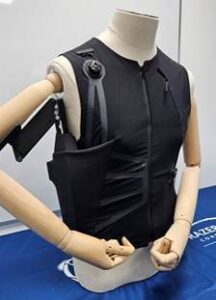 The early over-shoulder version was based on research from Stanford University, but during testing it became clear that it placed too much weight on the shoulders. Thanks to community feedback, the team moved to a wheelchair‑mounted, under‑arm design that offers much more comfort and stability.
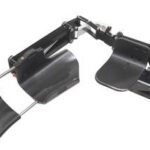
We now have a full‑arm prototype with integrated upper‑ and lower‑arm support. User testing has confirmed that the system works well, and we’re continuing to refine the mechanics, ergonomics, and appearance—making it more comfortable and more intuitive to use.
Who we’re working with
- Lived experience consultants – our design team includes two people living with DMD and SMA
- Inclusionaries Lab at the University of Liverpool – leading user engagement and design research
- Frazer Nash Engineering Consultancy – supporting our engineering team
- Pentagram – supporting the design language and overall aesthetic
 Hamane, Sam and Alex who have SMA have been involved in the project. Sam has recently been involved in the research for the aesthetics work with Pentagram. He gave us some great ideas last year about accessories and personalisation (he’s a film production student – he suggested a mount for the go-pro!). As he uses the Neater arm support Sam has provided us with lots of insights into how that works and the pros and cons of that system.
‘As part of the Elevex project, I have had inputs into the design of the device, which means that it is tailored to the needs of those who will benefit from it. For me, it will help with tasks around my career. Operating a camera is vital for me, and an attachment for this would be incredible!’ Sam Bolton
What are the next steps?
- Finalise the mechanical design, including getting it ready for manufacturing
- Carry out clinical safety and performance evaluations
- Complete the visual and design language with Pentagram
- Work toward medical device certification.
Read more in Duchenne UK’s Elevex Impact Report 2025 >
The Engineer’s 2023 Collaborate To Innovate (C2I) Awards.
 Now in its eighth year, these awards (C2I) were established to uncover and celebrate great examples of technology-led engineering with collaboration across a range of different disciplines and sectors.
Entries were judged by a panel of some of the UK’s leading engineers. They were awarded in February 2024.
The SMArt Suit was shortlisted and won in the folllowing categories:
- Grand Prix – Winner
- Healthcare and Medical – Winner
19th May 2022

A £1.25million grant from the People’s Postcode Lottery has enabled our partnership with Duchenne UK and the Inclusionaries Lab at the University of Liverpool to create a “SMART Suit” for people living with neuromuscular conditions.
SMA UK are proud to be working with a team of diverse and inclusive designers, engineers, child health professionals, product developers and people living with SMA and DMD to develop and bring to market this device that will push the boundaries of current assistive technology for people who have limited upper body movement.
The SMART Suit builds on the proof-of-concept prototype developed by Solid Bioscience. It will use powerful micro electric motor technology for robotic support. Combined with light weight, breathable and elastic fabric we will create the first SMART Suit designed for and with DMD and SMA users. It will have the potential for benefitting other neuromuscular conditions too.
Our aim is to produce a suit that users can wear discretely under clothes on their torso. It will help aid daily activities such as eating, getting ready for school and social interactions like taking a call or waving hello to a friend.
Toby Mildon, Trustee of SMA UK:
”As somebody living with SMA and a trustee of SMA UK I am personally very excited about collaborating on the SMART Suit project. Quite rightly, there has been a lot of focus on finding treatments for SMA and the development of genetic drugs… Hopefully, in the future a wearable suit that will help strengthen my upper body muscles so that I can do simple tasks like feeding myself dinner in the evening. Or lifting a pint in the pub!”