What is SMA Care UK?

What is SMA Care UK?
SMA Care UK is a 3 -year project established by clinicians and patient groups to update and implement UK Standards of Care for people of all ages living with SMA.
The current Standards of Care for SMA were written before disease-modifying treatments were only just beginning to emerge and were published in two articles in 2017. A Family Friendly Guide was published in the following year. They covered a wide range of topics such as nutrition and bone health through to respiratory care.
The new updated standards (SMA Care UK) will reflect how developments around treatments have changed the care and management needs of people of all ages living with SMA. Its goal is for this care to be accessible to all who have SMA, wherever they live and whichever hospital they attend. People living with SMA are central to this work. Given the wide-ranging impact of SMA, there are many areas of care to consider. Respiratory, hip, spine and transition to adult services are the first topics being reviewed.
 “After months of planning and working with a number of partners, clinicians and members of the SMA community we are delighted to formally launch the SMA Care UK project. It’s vital that the community help shape the new standards of care, and for that reason, we have created platforms to discuss the key topics and issued face for each of the revised standards.”
Giles Lomax, CEO
 “This is a great opportunity to improve care standards and equitable access to care for people living with SMA across all ages in the UK. I am excited to take this forward together with Dr Childs”
Professor Chiara Marini-Bettolo, Project Lead
 “I am delighted to be leading this much needed initiative with Dr Marini-Bettolo, bringing together clinical and patient experts to ensure that those living with SMA in the UK can access the best possible care”
Dr. Anne-Marie Childs, Project Lead
 “I am very excited to be managing such an important and impactful project, galvanising the clinical and patient communities to agree and ensure the best care for all who live with SMA.”
Vanessa Christie-Brown, Project Manager
Community experiences are key to shaping the updated UK Standards of Care for SMA. In this webinar, Portia Thorman (SMA UK Head of Advocacy & Community) and Vanessa Christie-Brown SMA Care UK Project Manager) speak with Kate and Connor about why lived experience matters.
Watch now to hear their insights and perspectives.
The first Standards of Care (SoC) for spinal muscular atrophy (SMA) were written in 2007. In 2017 the standards were updated and revised. However, the authors (Mercuri E et al. and Finkel R.S. et al.) were aware that countries have different levels of resources, so made recommendations based on the minimal care and support that anyone with SMA should receive irrespective of country of residence. They also acknowledged that more specific work needed to be done to address the SoC for adults.
The publication of these guidelines was welcomed globally by the SMA community and a corresponding guide for people with SMA and their families was produced by clinicians, academics, health care professionals and patient representatives (Spinal Muscular Atrophy UK, Cure SMA, SMA Europe, Muscular Dystrophy UK and TREAT-NMD) and published in 2017.
However, these revised Standards of Care for SMA were written before disease-modifying treatments were beginning to emerge. They covered a wide range of topics such as nutrition and bone health through to respiratory care.
SMA Care UK was born out of a need to update these 2017 SoC to reflect how developments around treatments have changed the care and management needs of people of all ages living with SMA. Its goal is for this care to be accessible to all who have SMA, wherever they live and whichever hospital they attend. People living with SMA will be central to this work. Given the wide-ranging impact of SMA, there are many areas of care to consider. Respiratory, hip, spine and transition to adult services will be the first topics to be reviewed.
SMA Care UK is following the successful approach of DMD Care UK and is working closely with their project team to share learning and maximise benefits for both patient communities.
These are to:
- Review the International SoC (2017) with clinicians and patients to identify key aspects of care that require revision / update in light of the changing SMA landscape.
- Establish a UK SMA SoC consensus for each area of care.
- Implement and disseminate a UK minimum recommendation for each aspect of care.
- Address inequalities in care for families and adults between different sites across the UK by campaigning for this UK standard to be accessible to all people who have SMA, no matter where they live.
- Identify areas of care where further work / evidence / research is needed and work with SMA Europe and other international groups to develop new consensus statements for specific elements of care.
- Link with ongoing international initiatives to update the SoC recommendations based on the evolving therapeutic landscape.
Clinicians and patient groups who worked up the project proposal looked at the topics that had been covered in the 2017 Standards of Care (SoC). They then added to them to reflect the changes in treatment, care and awareness since this time. They came up with these focus areas (in alphabetical order):
- Bone health
- Cognitive and speech development
- including language and social communication.
- Emergency care
- Medication
- New and emerging therapies:
- SMN1 replacement
- SMN2 upregulation
- non SMN pathway myostatin inhibitors etc.
- Evidence reviews of repurposed drugs
- e.g., salbutamol and pyridostigmine
- Combination therapies
- Neurorehabilitation
- Nutrition, gastrointestinal and bone health
- Orthopaedic
- Spinal management
- Hip management
- Other organs – the impact of SMA
- Palliative care
- Physiotherapy
- including participation in activities of daily living
- Diagnosis
- newborn screening
- neonatal
- paediatric
- adults.
- Psychosocial care
- emotional, psychological & mental health support
- Reproductive health
- fertility
- pregnancy
- woman’s health
- men’s health (aspects of andrology).
- Respiratory care
- Acute care
- Symptom management
- Transition
It would be impossible to work on all of the focus areas at the same time and important that the project produces some meaningful outcomes within 2 years.
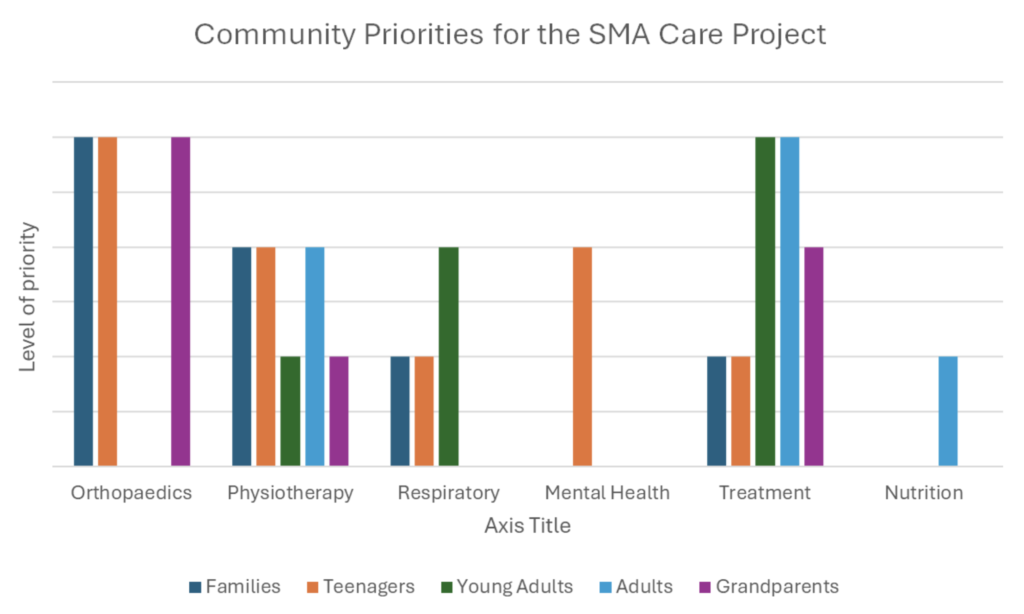
In May 2024, leading SMA clinicians across paediatric and adult specialist centres came together to decide which areas of care should be reviewed first. It was agreed that the first working groups selected had to be:
- Areas where there has been a significant amount of recent clinical research published, giving clear evidence.
- Areas that are a priority for both the SMA patient and clinical communities.
Following presentations from clinicians and SMA UK, as well as a poll on SMA UK’s what’s app groups, (see below), it was agreed that the first working groups would be:
- Hips (including monitoring and management)
- Breathing (Respiratory) – including acute care
- Transition into adulthood
The short answer is, ‘Yes’. Clinicians and patients at the different Centres around the country are constantly discussing changing ideas and possible options.
We also know that the SMA Community is better connected than ever before and that many discussions are had and issues raised through social media and our virtual networks. SMA UK has therefore already been tapping into this to gather ‘patient perspectives’ on topics that will be covered by the project. This will save time for when those topics become the next focus:
SMA UK also works with other patient groups and clinicians when we consider an area of care needs urgent attention:
The Steering Group identifies experts to lead Working Groups (WG) for each area of care. With the support of the Project Manager, each Working Group:
- includes experts in that area of care from paediatric and adult SMA REACH centres, patient representatives and other relevant health care professionals
- identifies specific concerns and queries being raised by the patient and clinical community
- looks at the current recommendations and knowledge and review evidence, research and the results of any patient surveys/ consultation
- works to achieve consensus around best care practice
- produces draft guidance that will be reviewed by clinical networks, patients and relevant professional bodies before final agreement
- seeks endorsement for the new consensus guidance from relevant national/ international professional bodies to optimise adoption of a specific area of guidance across wider networks.
With the support of the Project Manager, each Working Group will:
- seek to publish guidelines in peer reviewed medical journals
- present guidance to relevant conferences and meetings to increase awareness.
- produce community focused information that is accessible to the SMA community, including leaflets and web pages.
- identify training needs and consider how to best deliver relevant teaching / information across all the targeted stakeholders (patients and families, clinicians, and industry), using existing resources when feasible.
There are many opportunities to bring your experiences and expert perspective specific areas of the SMA Care project.
If you would like to join an expert working group, or review the draft guidelines as they are produced, then please register your interest here. Alternatively, please contact Vanessa Christie-Brown, SMA Care UK Project Manager at:
- If you are someone living with SMA: vanessa.christie-brown@smauk.org.uk
- If you are a healthcare professional: Vanessa.Christie-Brown@newcastle.ac.uk