Adults Living with SMA, Equipment
Adults Living with SMA, Equipment
Page last checked: January 2026
Standing Equipment
If you’re unable to walk, it’s still important to maintain activities like supported standing for as long as possible. Standing’s good for many things including:
- posture and range of motion
- preventing contractures
- breathing
- blood circulation
- bladder and bowels
- bones and joints.
Your physio or OT will provide equipment to support your standing and positioning. This may include a standing frame. They will tell you how often, when and where you should use any equipment.
Seating
The right seating is really important for your comfort and posture.
Options for people who can stand and walk
-
Riser Recliner Chairs
If you need to sit in a chair for any length of time, a riser recliner chair can be useful. This enables you to change position by reclining the back and / or lifting your legs.
To help you get up and out of the chair, usually the seat tips forward as well as rising. This can be unsafe for people with muscle weakness in their legs. You may need to consider a riser recliner which can be set to rise straight up without tipping. Ideally, any chair you’re thinking about should be trialled before it’s bought to make sure it’s both comfortable and safe to use.
Living made easy > – shows the range of different models – tick the boxes on the left hand side that apply to you. Your OT can advise on what features are right for you.
-
Perching Stools
These are useful in the kitchen or bathroom. You can use them for a short time to rest while carrying out personal care or household tasks. The seat’s angled forwards. The overall height of the stool can be adjusted as needed, for example to reach a sink or worktop.
Living Made Easy > – gives different options and ideas to discuss with your OT / physio.
If you’re a wheelchair user.
-
A full-time wheelchair user
You need:
- a firm base cushion which will encourage a level pelvis
- a firm back support which will encourage an erect posture
- arm rests at the correct height
- foot rests at the correct level so there’s a 90 degree angle at your hips, knees and feet.
If the seating in your chair is no longer comfortable or supportive, contact your physio or OT about a re-assessment. If you don’t have a physio or OT, ask your neuromuscular consultant or GP for a referral. You may also be referred to NHS Wheelchair Services for a review. See Tab 3 below.
-
Not a full-time wheelchair user
It’s still important that you get expert advice about any seating needs you have at home and work. This includes making sure that any wheelchair you use part-time is suitable for you. See the Mobility page >.
If you’re not being seen regularly by an OT or physio or neuromuscular consultant, ask your GP for a referral to one to assess your needs at home. If your seating at work is causing you discomfort or affecting your posture, talk to the manager responsible for your health and safety at work. If you haven’t already had an assessment you may be eligible to ask for one. See Tab 3 on our page Study, Work & Volunteering >.
Funding
If your OT assesses that you need specialist seating for home use they should be able to supply some free via the NHS or the Local Authority.
If you fulfil the eligibility criteria, seating needs for work may be funded. See Tab 3 on our page Study, Work & Volunteering >.
If you want to apply for help to buy additional or specialist seating See Tab 10 Funding for Equipment below.
This section looks at a variety of options, not all of which will be right for you. It will hopefully give you some ideas about what’s available to assist with your mobility.
The health authority is responsible for providing equipment for medical needs. This includes wheelchairs. How WS are organised and what they’ll fund varies from region to region. Many have a waiting list.
Powerchairs are complex pieces of machinery. They need maintenance and insurance cover. What you choose affects what vehicle you may need and potential adaptations to your home. You’ll need to work closely with your OT to trial and select the right one. They’ll advise you what help you can get with funding.
Washing and using the toilet
An occupational therapist (OT) can sort out equipment to make this personal care as easy and stress-free as possible. If you don’t have an OT, contact your GP or neuromuscular consultant and ask for a referral. Or you can self-refer to your local authority OT service for an assessment of your equipment needs at home.
Potential equipment includes:
- Using the bath: bath chairs, lifts, cushions, inserts and portable baths
- Showering: multi-function shower, toileting or commode chairs, mobile and wall-mounted shower cradles, benches and shower stools
- Using the loo: toilet seats, cushions, frames and rails, urine deflectors, travel urinals, wash and dry facilities.
Living Made Easy> – choose the top tab: Health and Personal Care and then Bathing & Toileting for ideas to discuss with your OT or physio.
Your OT should be able to advise what would work best for you. They should be able to provide most items of equipment and / or tell you how to get assistance to pay for them. See Tab 10. Funding for Equipment below.
Managing days out
Changing Places toilets > provide a height adjustable changing bench with a hoist and plenty of space. Visit their website for more information and a map > of where Changing Places can be found.
The National Key Scheme > for accessible toilets that can be found in shopping centres, cafes, department stores and in bus and train stations around the country. To unlock the toilets, you’ll need to buy a RADAR key >.
Clothing
Tips from our What’s App groups
Recommendations include:
- Able2Wear >
- Rackety’s >range sold by Fledglings, Contact charity’s not for profit shop
- Friendly Shoes >
- BILLY Footwear>range sold by Fledglings
If you’re having difficulty keeping your feet warm, have a look at the shop at:
You may need a specialist bed and / or mattress to keep you comfortable and safe at night. An example is an electric profiling bed that’s divided into sections. Areas of the bed can be positioned at different heights and angles, depending on what’s needed for posture and comfort.
Some people use a profiling bed which can be programmed to offer ‘side tilt’ during the night. This may mean that they don’t need a carer to turn them. There are also devices which can be fitted to standard profiling beds to assist carers to turn someone safely.
Mattresses need to be compatible with the bed. Different ones suit different preferences and needs. Some people use memory foam mattresses. Others are assessed as needing electric pressure-relieving mattresses. These give some change of movement and pressure areas throughout the night.
Some people also find it helpful to have a sleep system which uses wedges and rolls to support the body. Your OT can advise you what’s available and what may best suit your needs. If you don’t have an OT, you can ask your GP to make a referral.
Living Made Easy / Profiling Beds > are specialist ones you might discuss with your OT. Tick the boxes on the left hand side of the website page for what’s appropriate for you.
Some people find it useful to buy a portable electric pressure relieving mattress to take on holiday or for when they stay away from home. These can’t be funded via the NHS or Local Authority.
If you need to be moved or turned at night to keep comfortable, satin or cotton ‘slide’ sheets on top of the mattress can make it easier for whoever’s helping you. Alternatively, there are products such as Wendylett sheets and other devices which can be attached to a hoist. These can assist with turning you safely and comfortably.
Funding For Single & Double Profiling Beds
Generally, if you have a health or medical need, there should be no issue with the NHS supplying a suitable single profiling bed. This is via a district nurse.
If you need a double bed it may not be so straightforward. Ask your district nurse if this could be funded. Make sure to get supporting letters or information from your OT, physio or social worker.
If you get turned down, talk with your district nurse about the reasons. You may then work with them to apply for funding.
The reasons for being refused may be because positioning of a double profiling bed will compromise moving you safely – for you and / or your partner or PA . It’s hard to argue with that one.
If safety won’t be compromised, some options you might propose are:
- Seeing if a ‘twin’ single can be attached to the single that will be funded. This may effectively make a double. You could then propose that the NHS supplies the single and you fund the twin. See below for help with this.
- If a twin isn’t possible, suggest that the NHS part funds to the value of a single bed that they would supply. Then, with the support of your OT or physio or district nurse, look at suitable options. Ask them for a supporting letter to confirm that the bed you’ve chosen will work for you and is safe for both you and any PA.
For more suggestions see: Tab 10 Funding for Equipment below.
Beds are very personal. Ideally try before you buy. If the supplier won’t allow this, make sure that it can be returned if it is ‘not suitable’. Establish what reasons they consider ‘not suitable’ and that you agree are reasonable.
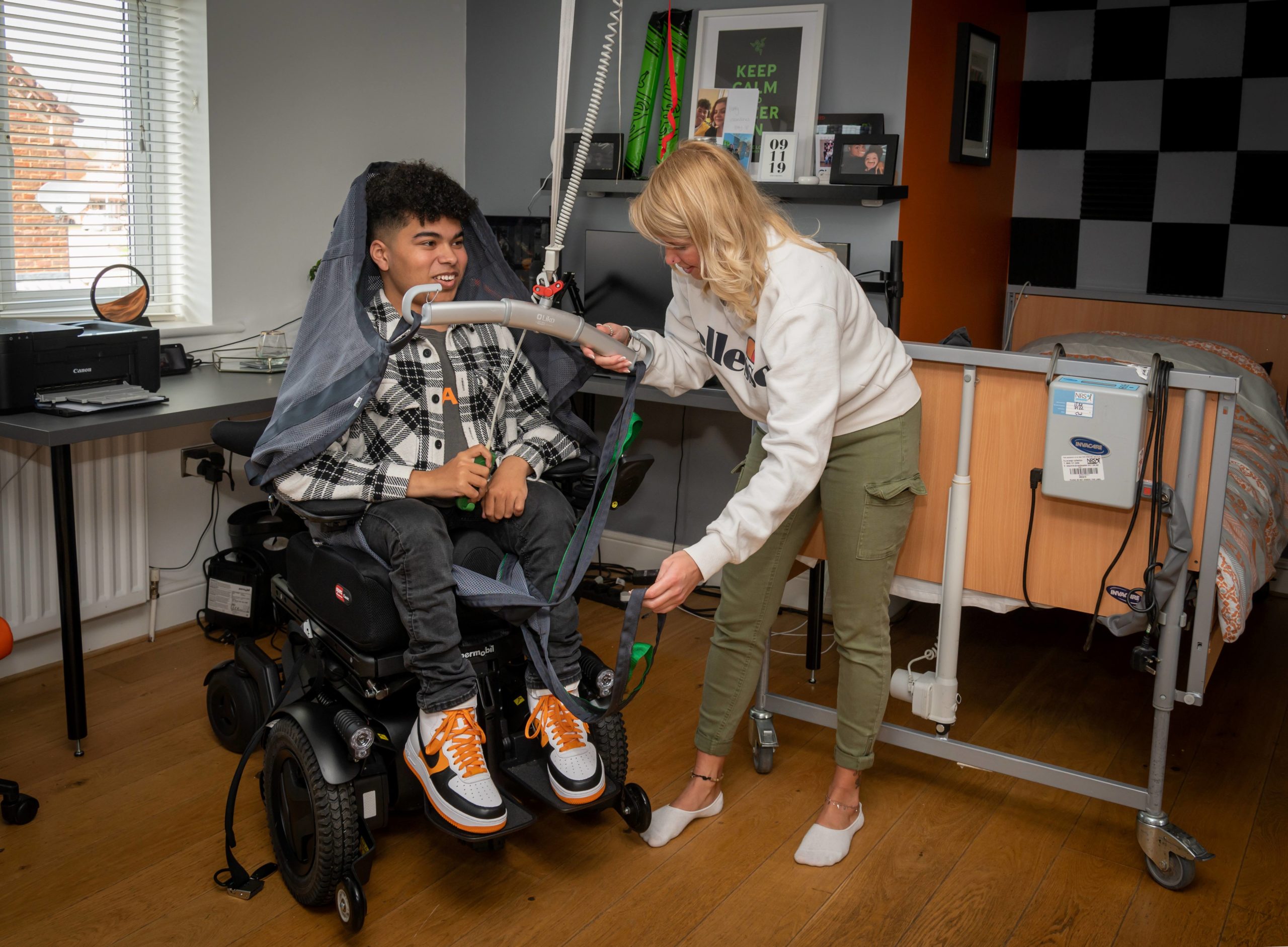
If transferring has become difficult or unsafe you may be thinking about getting a hoist. Some adults have said that they resisted using one for as long as possible. Their reasons were about wanting to maintain their independence. They saw it as extra equipment and extra hassle. However, if you’ve been assessed as needing to use a hoist when transferring, it will be for your safety and the safety of your partner or PAs.
Section last checked: January 2026
Many other items and accessories can make a difference at home and work. Some of these are small but impactful. For example:
- Automatic page turners, book holders and adapted pencil grips
- Ramps and grab rails
- Specialised handles and grips to help with eating and reaching.
Talk to your OT (occupational therapist) or physio about what help you need. They may well come up with a solution. If you have not got an OT or physio, ask your GP to make a referral for you. Your OT or physio can help you find out if the NHS or Local Authority (LA) can fund what you need.
LA budgets are limited. They may not cover every item that your OT suggests could be useful. There can be delays. Also, new products are coming on to the market all the time. If you do want to see what the range is, and potentially buy something, you may find it helpful to visit one of the: Equipment Exhibitions, Sport and Other Events > If possible, try before you buy.
If an item cannot be funded by the NHS or Local Authority but your OT or other professional agrees it would be a good idea, you may be able to get help with funding. See Tab 10. Funding for Equipment section below.
Check Health Or Local Authority Funding
Your OT or physio or specialist should be able to advise you. Funding for equipment for your daily use at your main home. It should broadly be as follows:Wheelchairs: you should be assessed by NHS Wheelchair services to see what funding they’ll give for which chair
Buying used disability equipment
If the NHS or Social Services can’t provide you with an item, this can be a good way to save money and get the products you need for daily living.
- Scope gives a summary > of things to think about and where to look.
- Skiggle > a charity that provides a place for people to turn to if they urgently need a piece of equipment or a disability care product.
Selling used disability equipment
If you have disability equipment that you no longer need, you may be able to sell it.
- Scope gives a summary > of suggestions for how to go about it.
Donating and recycling used disability equipment
There are several charities that accept donations of used disability equipment.
- Scope gives a number of suggestions >.
- Skiggle > charity that runs an online marketplace where people can safely give away and distribute disability care products and equipment
If you’re keen to try to pass on your equipment to other people affected by SMA, it might be worth checking if this is possible through one of the SMA online communities >.
These organisations also offer advice and hire equipment; others may be available:
British Red Cross > – to borrow or hire a wheelchair – age 5 years upwards.
National Mobility Hire > – for children’s lightweight wheelchairs as well as mobility aids for adults.
The Mae Murray Foundation Resource Library >in Northern Ireland has a wide range of equipment and resources which members may borrow. This may be possible for a holiday. They also have an inclusive beach loan scheme >.
Equipz > – Disabled Living’s services which relate to the provision of information and advice about equipment and services.
Naidex > – The UK’s leading trade and consumer event for disability, accessibility, and independent living .
Kidz to Adultz exhibitions > – Organised by Disabled Living, these are five of the largest, free UK exhibitions focused on the needs of children and young adults aged up to 25 years.
To print a copy of this page, click the print icon below.
Please get in touch > if you:
have questions we haven’t answered
need support.