Drug Treatments for Children who have 5q SMA – Scotland
Drug Treatments for Children who have 5q SMA – Scotland
You can:
Download a printed pdf version of this information here >
Ask us to send you a printed version: publications order form >
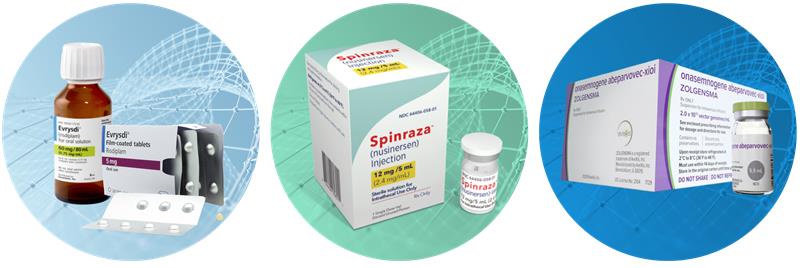
This guide gives short answers to the common questions families have about the three NHS-funded drug treatments.
- Nusinersen (SpinrazaTM)
- Onasemnogene abeparvovec (ZolgensmaTM)
- Risdiplam (EvrysdiTM)
For ease of reading, in this summary we
- use the trade name Zolgensma rather than that drug’s’ generic name.
- refer to parents. This includes caregivers.
Decisions about treatment can be complex.
Each child and family’s situation and circumstances are different.
We recommend you discuss any unanswered questions
with your child’s clinical team.
In Scotland, the Scottish Medicines Consortium (SMC) approves treatments that are then funded by the NHS.
Children may be treated as follows:
- Nusinersen – those who have SMA Type 1, 2 or 3
- Risdiplam – those who have SMA Type 1, 2 or 3 or 1 – 4 SMN2 copies
- Zolgensma – those who have SMA Type 1 and 1 – 3 SMN2 copies
Children who have been diagnosed with SMA Type 1
If they are well enough, these children may have whichever of the three treatments is the most suitable option. You can read more about how they work and are given in the sections below. The child’s clinician will discuss this information with parents so that they can jointly decide about treatment for their child. It is important that the risks and benefits are carefully considered.
Risdiplam and nusinersen cannot be used in combination.
Zolgensma treatment has some very specific pre-treatment requirements. Children must:
- weigh less than 21 kg. As risks increase with weight, children over 13.5 kgs should only be treated in specific circumstances.
- have a number of blood tests to make sure the treatment is safe for them These tests include how well their liver, kidney and heart are working.
- have an AAV9 antibody test
These tests take time. The SMA REACH UK clinical network recommend that:
“If it is decided that Zolgensma is the best option, a bridging therapy should be started urgently.” This would be risdiplam treatment.
Nusinersen or risdiplam can only be prescribed following Zolgensma treatment if that treatment has not been successful.
Children who have been diagnosed with SMA Type 2 or 3
If they are well enough, these children may have nusinersen or risdiplam treatment, whichever is the most suitable option.
These babies are pre-symptomatic. They may be identified in one of three ways:
- Their siblings have SMA. They may be identified during pregnancy or at birth.
- When a baby is born in an area that is part of the Inservice Evaluation of Newborn Screening for SMA > . Scotland is one of these areas. Parents may choose to have their baby tested for SMA.
- When parents have chosen for their baby to take part in the Generation Research Study >
Babies who have between 1 and 3 copies of the SMN2 gene
These babies may have risdiplam or Zolgensma treatment, whichever is the most suitable option.
You can read more about how the treatments work and are given in the sections below. The child’s clinician will discuss this information with parents so that they can jointly decide about treatment for their child.
Zolgensma treatment has some very specific pre-treatment requirements. Children must:
- weigh less than 21 kg. As risks increase with weight, children over 13.5 kgs should only be treated in specific circumstances.
- have a number of blood tests to make sure the treatment is safe for them These tests include how well their liver, kidney and heart are working.
- have an AAV9 antibody test
These tests take time. The SMA REACH UK clinical network recommend that:
“If it is decided that Zolgensma is the best option, a bridging therapy should be started urgently.” This would be risdiplam treatment.
If test results are all satisfactory, the bridging therapy would stop when the child is treated with Zolgensma.
Nusinersen or risdiplam can only be prescribed following Zolgensma treatment if that treatment has not been successful.
Babies who have 4 copies of the SMN2 gene
These babies may have risdiplam treatment, whichever is the most suitable option.
People with SMA do not have enough of a protein called ‘survival motor neuron’ (SMN) protein. This protein is essential for the nerve cells, known as motor neurons that help control muscles. Motor neurons are found in the brain and spinal cord, and they make contact with muscles.
The SMN protein is made in our cells from two genes, SMN1 and SMN2. People who have SMA have:
- two ‘altered’ copies of the SMN1 gene. These are unable to produce enough SMN protein to have healthy lower motor neurons.
- a number of copies of the SMN2 gene. This is often called the back-up gene. It mostly produces a short SMN protein that does not work as well as a full-length protein.
All three treatments increase the amount of SMN protein found in cells throughout the body. They do this in different ways.
Nusinersen and Risdiplam
Nusinersen is a small piece of genetic material (a synthetic antisense oligonucleotide).
Risdiplam is a small molecule drug.
Both of these treatments target the ‘back-up’ SMN2 gene. They make the gene produce more usable full-length SMN protein.
Zolgensma
This is a gene therapy. It delivers a healthy copy of the SMN1 gene to motor neurons. The gene is packaged inside an inactive shell of a virus called AAV9 (adeno-associated virus 9). This is so that it can be transported to the target cells.
None of the treatments is a cure. This is because:
- Timing is critical. Treatments can quickly boost SMN protein after they are given. But, by then, some damage may be irreversible. This may happen even before a baby is born.
- It is unknown if the treatments will have lasting effects.
They are often called disease-modifying treatments.
Nusinersen
This is given by lumbar puncture >. A needle is inserted through the skin into the space between the back bones of the spine (vertebrae) into the fluid that flows in and around the brain and spinal cord (cerebrospinal fluid -CSF). Doctors, or other trained healthcare professionals, usually use a local anaesthetic when they do this. If a sedative or general anaesthetic is needed, the doctor will decide if this is safe for you or if a different treatment should be considered.
The total length of time the procedure takes will vary. The injection itself takes between one and three minutes.
Biogen is working with the Scottish Medicines Consortium (SMC) to ensure equitable access to Higher Dose nusinersen in Scotland.
12mg dose nusinersen
‘Loading doses’ are given to get the level of the drug to an effective concentration within the CSF. These are:
- On the first day of treatment, day 0
- Then around day 14, day 28 and day 63
- There should always be at least 14 days between doses.
After this maintenance doses are given every 4 months. This maintains the drug concentration level in the CSF.
Higher Dose nusinersen
If this is approved for use in Scotland, it will have a more rapid loading phase than the current dose people in the UK receive. There would be:
- two 50 mg loading doses administered on day 0 and day 14
- then 28 mg maintenance dose injections every four months.
If children who are currently receiving 12mg nusinersen switched to HD nusinersen they would have a different dosing schedule:
After the last dose of 12mg nusinersen, they would need :
- one dose of 50 mg administered at least 4 months (plus or minus 14 days) after the last does of 12mg
- the maintenance dose of 28mg every 4 months after that
Zolgensma
This is a single one-time treatment injected into the bloodstream (intravenously). A small flexible tube (cannula) is placed into a vein in the arm or leg using a needle. The needle is then removed leaving the cannula in place for the infusion. Sometimes, for safety reasons, two cannulas are inserted. It takes about 60 minutes to deliver the treatment.
The care and management needed before and after treatment can be very intense. For example:
- Contacts need to be limited to help prevent infections
- A high standard of hand hygiene and careful disposal of nappies is essential for at least a month after the infusion
- Hospital visits and regular blood tests are needed for at least the first 2 – 3 months after treatment. Blood tests can be as often as twice a week. Occasionally the blood tests may be needed for many months.
- To reduce side effects, corticosteroids are given before and after the treatment. This is for at least three months, usually by mouth. After that time, the treating doctor assesses when and how they can be stopped. It is not safe to suddenly stop steroids.
Risdiplam
The tablet form
A child must be 2 years of age or older with a body weight of 20 kg (44 lbs) or more. They must be able to swallow without the use of a feeding tube.
The tablet is taken daily at home at approximately the same time each day. It:
- can either be swallowed whole or dispersed in water
- can be taken with or without food
- does not require refrigeration
- can be stored at room temperature.
The liquid form
This does not have an age restriction. It is:
- given at home
- taken daily after a meal, at approximately the same time each day
- given by mouth (orally) or feeding tube, using the syringe that comes with it
- provided in a bottle in a box that must be kept in the fridge and out of the light
- comes with instructions about how long it is safe to keep it out of a fridge and what is the allowed maximum temperature.
You can read more about storing the liquid form of risdiplam in Roche’s Patient Information Leaflet >
All three treatments reach the motor neurons to treat SMA.
All three treatments reach other types of cells. The extent of this, and any potential benefits, are unknown.
Nusinersen
This reaches the motor neurons and other cell types in the spinal cord. It may have limited ability to reach other parts of the body due to the ‘blood-brain’ barrier.
Zolgensma
This travels through the bloodstream. It reaches the brain and motor neurons, delivering SMN protein throughout the body.
Risdiplam
This reaches many different types of cells, tissues and organs in the body.
Your clinical team will discuss the possible risks and benefits of each treatment with you.
You can read more on this topic if you follow the links at the top of this page. Each treatment also has a detailed Patient Information Leaflet:
There are no clinical trials or studies that directly compare the effects of these treatments.
- Nusinersen has been tested in clinical trials in humans since 2011.
- Zolgensma has been tested in clinical trials with young children since 2014.
- Risdiplam has been tested in clinical trials in humans since 2015.
In these trials, all three treatments have been consistently shown to have an acceptable safety profile. All three have also been shown to be well-tolerated.
When compared to no treatment, all three have led to clinically meaningful improvements in muscle function.
The long-term outcomes and the specific outcomes for any individual child are uncertain.
Your child’s clinical team will know about the clinical trials for each treatment. They will have ‘real world’ information that is being collected and discussed all the time.
- Biogen told us their latest update was that more than 14,000 people had been treated with nusinersen.
- Roche told us that by August 2025 , 21,000+ individuals have been treated with risdiplam worldwide
- Novartis Gene Therapies told us that by September 2025 more than 5,000 babies had been treated with Zolgensma globally. This had been through clinical trials, early access programmes and commercial use.
 Version 2
Author: SMA UK Information Production Team.
Published: May 2026
Next Full Review due: May 2029
Links last checked: May 2026
This page, and its links, provide information. This is meant to support, not replace, clinical and professional care.
Find out more about how we produce our information.