Media Centre
Media Centre
Founded in 1985, SMA UK is a national charity who:
- Produces reliable, timely information on SMA for the SMA Community as well as health care professionals, education providers and the general public.
- Provides personalised practical and emotional support services for all those affected by SMA through our Outreach Team, events and communitiy networks.
- Advocates on behalf of the SMA Community to authorities that regulate access to drug treatments, care and services and campaigning on issues that matter to people affected by SMA.
- Fund and support research into the clinical development of drug treatments that understand the complexities of SMA and the underlying disease mechanisms and improvements in the clinical care and management of people affected by SMA.
What is SMA?
Spinal Muscular Atrophy is a rare, neuromuscular condition. It causes progressive muscle wasting (atrophy) and weakness. It may affect crawling and walking ability, arm, hand, head and neck movement, breathing and swallowing. How severely people are affected, and in what way, varies greatly.
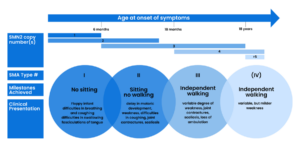
SMA is divided into four main Types of SMA: Types 1, 2, 3, and 4. Sometimes a baby is affected before birth; this is called Type 0.
These ‘Types’ of SMA are based on the age that symptoms begin, and what physical milestones (e.g. sitting, standing, walking) are achieved. How severe and what impact SMA has varies from person to person, both within and between ‘Types’. Each child and adult is affected differently.
What causes SMA?
Most people have two genes called the Survival Motor Neuron 1 (SMN1) gene. This produces Survival Motor Neuron (SMN) protein which keeps lower motor neuron nerve cells healthy.
These nerve cells are essential for activating muscles used for crawling and walking, the movement of arms, hands, head and neck, as well as breathing and swallowing.
Most people have two healthy copies of the SMN1 gene. People who have 5q SMA have two ‘altered’ copies of the SMN1 gene. This means they are unable to produce enough SMN protein to have healthy lower motor neurons. As a result, the lower motor neurons in the spinal cord deteriorate.
The statistics
- In the UK, 1 in 14,000 babies are born with SMA.
- That means 47 babies each year are born with SMA
- Around 4 babies are born with SMA each month in the UK
- Approximately 60% of babies born will have SMA Type 1 (the most severe form of the condition)
- An estimated 1 in 40 people carry the altered gene (around 1.7million people in the UK)
- When two ‘carriers’ of the altered gene have a child, for each and every pregnancy there is a one in four chance that the child will have SMA.
- All 50 states in the United States screen as well as approximately a total of 18% of the world including Canda and Australia
- 79% of the European Union screen (75% Geographical Europe)
- Austria implemented SMA screening within two months of a ministerial decision with Denmark and Switzerland taking 3 months. It only took Poland Six weeks to implement from the ministerial decision.
- Our closest European country, the Republic of Ireland are due to screen in Spring 2026.
- Despite the war, Ukraine rolled out SMA screening in October 2022. Over an 18-month period they screened 211,000 babies and found 31 positive cases.
- Those babies were treated and are following normal developmental pathways.
Landscape of Newborn Screening in UK
The NHS currently offers newborn blood spot screening (using a heel prick to take blood) when a baby is 5 days old. This is carried out by the midwife or health visitor and It currently looks for 9 rare but serious conditions such as cystic fibrosis.
The heel prick test does not currently include SMA despite clear evidence that early diagnosis and treatment of SMA leads to better outcomes.
Early detection of the condition is critical.
Any recommendations for any new conditions to be added to the bloodspot programme are decided by the UK National Screening Committee (UKNSC).
The UK has one of the lowest number of conditions on the screening programme compared to 30 or more in some European countries and up to 65 conditions in the USA.
The cost of a newborn screening test in the UK
The cost for the test (called qRT-PCR test) which is required for SMA is £4 per test.
This is the figure that is generally accepted. In May 2024, published through the Journal of Neurology and Therapy showed the figure was £4.54 (a Dutch value, which is in line with other sources in Europe, converted to GBP because of lack of UK-specific data).
In August 2025, the UK National Screening Committee (NSC) published the data below.
Newborn screening background including facts and figures
The figures below are the 2024 Births in the UK (rounded up). 2025 figures are not released yet.
- England 567k
- Wales 27k
- Scotland 46k
- NI 20k
Total 660k
Timelines and In-service Evaluation (ISE)
October 2018: SMA rejected to be added to the heel prick test as Spinraza (1 of the 3 treatments) had just come out but there wasn’t enough evidence of real-world data to suggest meaningful gains would be made.
June 2023: The UK NSC announced plans to review if SMA should be added to the heel prick test and said that this would be done two- fold
- run an In-Service Evaluation (ISE) of newborn screening for SMA. This is similar to a pilot study and is seen as a vital step towards making screening routine across the UK.
- Developing a new cost-effectiveness model to understand if NBS is cost effective.
May 2025: The National Institute of Health Research’s (NIHR) released details of how researchers could apply and scope what the ISE would look like.
August 2025: After two years and still no babies tested, the UKNSC published data showing that NBS was cost effective for SMA but still wanted to go ahead with an ISE rather than going live and rolling out screening immediately.
December 2025: An NHS England implementation group met to work working detailed planning for the ISE in England.
22nd January 2026: National Institute of Health Research’s (NIHR) formal application closes.
March 2026: The decision about who will undertake the research should be made by the National Institute of Health Research’s Health Technology funding committee. There has been one application made up several leading researchers and Universities including SMA UK.
These plans are to start screening from January 2027 on a phased approach based on the current NBS sites that have the appropriate and existing equipment needed for SMA (not in order).
- Manchester
- Sheffield
- SW Thames
- GOSH
- Newcastle
- SE Thames
- Birmingham (will have the right kit in April 2026)
In the UK there are 14 NBS sites so only half will be selected.
Jan 2028: 7 sites up and running with 404k babies screened annualy by this point. However, this means that 163k will not be screened until the UK NSC makes a formal recommendation to introduce routine screening for SMA which could be 2030/31 at the earliest.
In practical terms this means, If you are born outside of the above areas you will not be screened.
We are absolutely delighted to hear the news that NHS Scotland will be adding SMA to their newborn screening programme in an evaluative and research capacity with the aim of the first baby being tested in early 2026.
In September 2025, the Scottish Government announced the news via ministers (Neil Gray Cabinet Secretary who is Wes Streeting equivalent) and will be screening the entire country for 2 years starting in April 2026. The data generated will be used to support the UK NSC decision making process.
External funding will be used to help purchase specialist testing equipment for the Scottish Newborn Screening Laboratory in Glasgow, and with only one testing site in the country, this means that every baby born will be screened for SMA, approximately 45,000 each year (45,763 live births in 2024). With clinical pathways already established and disease modifying treatments approved, this means those babies born will be treated pre- symptomatically and can therefore, in many cases, follow normal developmental pathways.
The data generated over a 2-year period from Scottish Newborn Screening Laboratory will complement and help contribute to the UK In-service evaluation ultimately helping towards a positive UK NSC decision for SMA to be added to the bloodspot programme.
SMA UK were at the forefront of making this happen and this is a hugely positive step forward with Scotland joining other countries around the world who already screen for SMA.
Scotland, Wales and Northern Ireland are not included at all in the ISE as they don’t receive funding from NHS England.
As a result Wales and Northern Ireland will need to wait until 2030/31 for the UK NSC to decide. Both of these countries only have 1 screening laboratory each.
There is no cure for SMA and until late 2019 there were no NHS-approved drug treatments specifically for SMA in the UK. There are now three NHS-funded drug treatments:
- Spinraza™ / nusinersen (once every 4 months)
- Evrysdi™ / risdiplam (taken orally everyday)
- Zolgensma™ / onasemnogene abeparvovec (one time gene therapy)
These drugs, better care and management of the condition can change what motor milestones (e.g. the ability to sit, stand and walk) babies and children may be able to achieve, and improve their general health. For example treatments have been shown to improve or stabilise, bulbar function (both speech and swallowing), respiratory function (impacting cough strength and volume of voice) and has improved the mental wellbeing of people with SMA and their families.
The treatments work best if started before there is any muscle weakness, or when this is minimal. It is therefore important for treatment to be started as soon as possible.
It’s really important to note that both Spinraza (nusinersen) and Risdiplam (Evrysdi) are not fully approved in the UK. For several years, these treatments have been available via a Managed Access Agreement (MAA). This was essentially a “probationary period” where the NHS funded the drugs while data was collected to prove their long-term effectiveness.
The Multi-Technology Appraisal (MTA) Appraisal process
The Multi-Technology Appraisal (MTA) for the Spinal Muscular Atrophy treatments Spinraza (nusinersen) and Risdiplam (Evrysdi) is currently being conducted by NICE (the National Institute for Health and Care Excellence).
SMA UK have led on collecting and summarising real world evidence about the impact on these treatments for the NICE committee meeting to consider, along with the data from pharmaceutical companies and specialist clinicians.
The Committee reviews all the submitted data to assess the efficacy and cost effectiveness of the two drugs.
The current MTA is the final assessment to determine if these treatments are cost-effective enough to be transitioned into routine commissioning, meaning they become a permanent part of NHS care.
November 2025, the NICE Appraisal Committee held a crucial meeting to review the evidence. Patient experts from SMA UK and other organisations attended to ensure the voices of the SMA community were heard.
November to present, NICE have paused the process to allow for further negotiation and data refinement.
This pause occurred because SMA UK and the clinical experts argued that the current “modelling” (the math used to value the drugs) was too narrow. NICE has asked the pharmaceutical companies to provide more robust evidence.
It is vital to note that while this evaluation is ongoing, access to both treatments is protected.
3rd February 2026 NICE is reconvening the committee to review this updated information and issue a final recommendation. The patient experts will be present to give their perspectives as well as the pharmaceutical companies.
 Giles Lomax, CEO SMA UK
Giles joined SMA UK in May 2023 as Chief Executive Officer, leading the charity into its next phase of development and impact.
Giles brings over 12 years’ experience working across National Governing Bodies for sport and within a not-for-profit local authority, alongside holding a number of board-level positions.
As CEO of SMA UK, Giles is committed to driving the charity’s mission forward — raising awareness of spinal muscular atrophy, advocating for individuals and families, and working to ensure timely access to diagnosis, effective treatment and best-practice care for everyone affected by SMA.
Giles brings both professional expertise and personal insight to his role. He is the father of twins who have SMA Type 2, giving him a deep understanding of the physical and emotional impact of the condition and reinforcing his commitment to listening to and supporting the SMA community in making informed choices.
 Portia Thorman, Head of Advocacy and Community, SMA UK
Portia joined SMA UK in 2022 as Advocacy Lead, bringing strong community insight and lived experience to the charity’s policy and advocacy work.
Through her close links with the SMA community, Portia works to advocate for improved access to treatments, therapies and services for everyone living with spinal muscular atrophy.
Portia is the mother of four children. Her youngest son, now nine, lives with SMA Type 1 and was one of the first children in the UK to receive treatment for the condition in 2017. Due to a late diagnosis, he lives with complex needs — an experience that strongly motivates Portia’s advocacy work.
Portia holds a degree in Psychology and has 11 years’ experience as a primary school teacher, bringing a strong understanding of child development, education and family support to her role at SMA UK.
 Dr Anne-Marie Childs, Consultant Paediatric Neurologist and Lead for Neuromuscular Conditions at Leeds General Infirmary, SMA UK Trustee.
Anne-Marie has been leading the neuromuscular service since 2000. She is a member of the SMA REACH network, clinical expert for NICE and NHSE and a trustee for SMA UK. She is committed to ensuring that those living with SMA in the UK receive the best possible care.