The Casey Commission
The Casey Commission
Page last updated: 17th August 2026
Led by Baroness Louise Casey, this commission is laying the groundwork for a future National Care Service.
17th August 2026
Care and Support Alliance (CSA) – Community Request
The CSA is looking for people whose experiences clearly demonstrate the postcode lottery. For example, someone who has moved between local authority areas and received very different support.
Real stories will help show that these figures aren’t just statistics.
Can you help? If you know someone who might be willing to share their experience, please contact them as soon as possible at csa@nas.org.uk
29th July 2026
Baroness Casey Launches the Big Conversation on care with the public
Launched today, this is the most ambitious public conversation in a generation.
Between now and April 2027, The Big Conversation will give people across England the opportunity to say what they want and expect from a future National Care Service. This includes the tough questions about:
- who it should support
- what families should reasonably be expected to do
- how the country should pay for care in a fair and sustainable way.
The Big Conversation will aim to engage with one million people across England. It’s open to everyone through a new online platform launched today:
Baroness Casey has agreed to provide the Independent Commission’s recommendations by summer 2027.
June 2026
SMA UK’s Adult Advocacy Steering Group Responds
SMA UK’s Adult Advocacy Steering Group >, is fighting for a system that moves away from crisis management and toward a system that treats social care as an investment in independence.
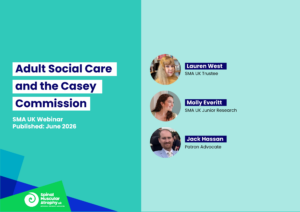
Lauren West and Jack Hassan both have extensive experience of the social care system. They discuss what the future of social care reform could mean for people living with Spinal Muscular Atrophy (SMA) with host Molly Everitt. Watch now >
March 2026
Baroness Casey recommends the Government take six immediate actions
These are on dementia, motor neurone disease and adult safeguarding due to the urgency of the reform needed in these areas.
Read her recommendations recommendations >
Casey Commission questions
Can you give up to three examples of things that work well or new ideas you have seen in adult social care?
Based on observed practice and new developments, here are three examples of effective initiatives in adult social care:
1. Enhanced Quality Assurance via Dedicated Response Teams
The establishment of a specialised Complaint Response Team shows a clear commitment to quality assurance. This model ensures that complaints are dealt with in a timely manner, such as through prompt virtual meetings, demonstrating accessibility and swiftness. Crucially, the involvement of the Principal Social Worker (PSW) allows for direct learning, addressing practice issues immediately with the worker and their manager. This successfully turns complaints into immediate learning opportunities, rather than purely administrative tasks.
2. Practice Improvement Cycles (PICs) for Accountability
While effective in addressing complaints, a common challenge is ensuring the agreed plan translates into sustained change. A new idea is the mandatory implementation of Practice Improvement Cycles (PICs). Following a complaint resolution, the PSW would be required to perform a 90-Day Practice Implementation Check. This high-level clinical follow-up ensures the actioned plan has genuinely come to fruition, preventing issues like poor communication or delayed outcomes from continuing after formal closure. This moves accountability from process to outcome.
3. Utilising Virtual Platforms for Engagement and Review
The use of virtual platforms (e.g., secure video meetings) for complaint discussions, care planning, and routine reviews is a working success. This approach dramatically improves accessibility and reduces waiting times. Standardising secure video check-ins for complex cases offers immediate feedback and transparency, mitigating poor communication and ensuring consistency. This helps to close the gap between planning and delivery, making services more responsive and user-centred.
Can you give up to three examples of things that don’t work well in adult social care?
1. Systemic Delays and Inflexible Assessment Processes
Adults face excessive waiting periods for initial needs assessments and statutory reviews. This is compounded by an over-reliance on unnecessary re-assessments during routine reviews, even when needs are stable. This rigid, time-consuming approach often leads to care packages being reduced and results in local authorities delaying the provision of essential social care, placing immense pressure on families and significantly increasing risk to the individual. Furthermore, the approach is often one-size-fits-all, negating the holistic, person-centred focus required by the Care Act, particularly for individuals with complex or degenerative conditions.
2. Crisis in Care Quality and Carer Recruitment
There is a worrying inconsistency of care and carers, largely due to a lack of experienced staff who are unable to meet complex needs. This quickly leads to care package breakdown, leaving families as the only alternative care providers, often to the detriment of their own health. While Direct Payments (DPs) offer choice, their effectiveness is undermined by local authorities offering only the minimum wage, making it increasingly difficult to recruit and retain Personal Assistants (PAs). This, coupled with a severe lack of support for DP employers when issues arise (e.g., employment law), leaves individuals overwhelmed and vulnerable.
3. Inconsistent Professional Engagement and Support Discrepancy
The sector suffers from a wide disparity in professional willingness to engage with the voluntary sector and charities, with some viewing them as interfering rather than as valuable partners who hold the adult’s voice and specific knowledge. Critically, there are profound inconsistencies and discrepancies in care provision across the UK and even between different individuals with similar needs. This shows a poor understanding of lifelong/degenerative conditions and results in adults having to fight for fundamental elements of well-being that are needs, not wants.
Can you give up to three examples of things that waste time, money, or effort in adult social care?
1. Duplication and Fragmentation in Assessment
The system wastes significant effort through repeated, uncoordinated professional visits (e.g., multiple visits from physiotherapy, OT, and rehab teams) to gather evidence for a single assessment. This fragmented approach leads to confusion, mistrust, and a poor experience for the individual. The fundamental failure to complete the assessment or support plan in a timely manner, even in an emergency, necessitates multiple assessor visits with no outcome, wasting staff time and delaying essential care packages for weeks, as seen in the six-week wait for an ‘emergency’ service.
2. Inefficient, Defensive, and Non-Person-Centred Reviews
Reviews frequently become a waste of money and time by forcing unjustified re-assessments that result in reduced care packages, even when needs have not changed. This creates a highly adversarial system where the individual is forced to spend significant time and effort challenging decisions (taking over a year in some cases). The system is further bogged down by long pauses and fragmented responses to correspondence, consuming staff resources on protracted, unnecessary disputes instead of focusing on current and future care needs.
3. Lack of Consistency and Strategic Integration
Effort is wasted as individuals and carers are passed from pillar to post between departments and different professionals. The common practice of assigning a new social worker for every review ensures a perpetual lack of case-specific knowledge, requiring the new worker to re-familiarise themselves, which is highly inefficient. Furthermore, the lack of strategic commissioning and proper integration between health and social care results in minimal, often insufficient care (e.g., 15-minute care calls) that fails to offer dignity or quality, leading to rapid care breakdown and reliance on unsupported informal carers.
Would you like to share any research with the Commission?
Read our May 2025 Adult Perspectives Report >