In order to promote exercise in the SMA community, we need to first better understand the barriers that people are facing. This led to a survey which was circulated prior to the SMA Big Weekend in September 2025.
We know that exercise is safe for people with neuromuscular conditions and there is growing evidence of the benefits it may bring to people living with SMA. Despite this, a recent study surveying 830 people living with neuromuscular conditions that attend the John Walton Muscular Dystrophy Centre in Newcastle found that only 8% were meeting the nationally recommended levels of physical activity, compared to 65% of the general population. People living with SMA were the most likely to be sedentary and only 4% achieved recommended levels of physical activity.
Results
57 people completed the survey with an even representation between adults and children, and SMA Types I, II and III. The overwhelming majority (96%) believed that everybody living with SMA can benefit from exercise. Many positive outcomes were reported (Figure 1) – including improvements in function, strength, general health and mood. There were much fewer negative outcomes, but it was clear that fatigue is a significant issue as it was reported by around half of respondents.
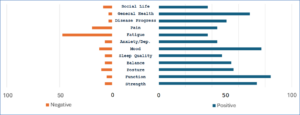
Figure 1: Percentage of respondents anticipating a positive or negative response from exercise in relation to different outcomes.
Responses were grouped according to the COM-B model, which recognises that for anyone to carry out a behaviour, they need to have the Capability, Opportunity and Motivation to do so. This was then visualised into radar plots (Figure 2) which summarise capacity to exercise under five domains related to these areas. A lower score indicates more significant barriers.
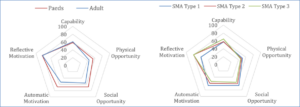
Figure 2: Radar plots demonstrating Capability, Opportunity and Motivation to be physically active amongst adults and children living with SMA Type I, II and III.
Across all respondents, there was a high motivation to exercise but opportunities were found to be limited. In particular, this related to insufficient access to facilities, equipment and support.
This barrier was felt more significantly by the adult respondents, highlighting the drop off in exercise provision after transition from paediatric services. Beyond issues around access, adults also felt less encouraged to be active by healthcare professionals and were less likely to have exercise built into their daily routine.
Unique barriers were seen for each SMA type, indicating that bespoke solutions may be needed depending on individual circumstances.
Further insights were revealed from additional comments left by respondents. Key messages revolved around inconsistent NHS provision and the postcode lottery of accessible sport and hydrotherapy opportunities. There was a feeling that exercise should prioritised in order to maximise the impact of disease modifying therapies but a desire for it to be social and enjoyable, rather than clinical.
Next Steps
These findings will be further explored through qualitative research with focus groups currently being conducted. This, in turn, this will feed into the SMA Care UK Exercise Working Group which will be informed by the patient community and bring together specialist clinicians, community teams and service providers to update the exercise guidelines for SMA.
Note: These are early, preliminary findings shared with the community in the spirit of transparency and engagement; a formal analysis is being prepared for academic publication.
We are grateful to everyone who took the time to share their experiences at the SMA UK Big Weekend and for the continued engagement of the SMA community on this topic.