Drug Treatments for Adults who have 5q SMA – UK
Drug Treatments for Adults who have 5q SMA – UK
You can:
Download Looking after Type 1 V19 Drug Treatments for adults V3
Ask us to send you a printed version: publications order form >
The National Institute of Health and Care Excellence (NICE) made final recommendations on this topic > on the 4th June 2026. This page includes these updates.
NHS England is now implementing the recommendations.
Wales and Northern Ireland usually follow NICE guidance.
Scotland has a separate system. We explain when practice in NHS Scotland may be different for adults
- Nusinersen (SpinrazaTM)
- Risdiplam (EvrysdiTM)
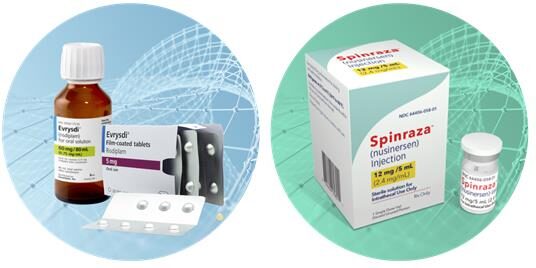
Decisions about treatment can be complex.
Each person’s situation and circumstances is different.
Your discussion with your clinical team will be much more detailed.
If your clinician does not already have genetic test results that confirm you have 5q SMA they will:
- arrange for you to have a blood test. This will confirm if your SMA is caused by alterations in the SMN1 genes. It will also show how many SMN2 gene copies you have.
- ask you when your symptoms started and how your condition has progressed.
This is so they can work out if your clinical diagnosis is Type 1, 2, 3 or 4 and discuss treatment and care options with you.
The UK Medicines and Healthcare products Regulatory Agency (MHRA) licences state that:
- nusinersen may be prescribed to all who have 5q SMA.
- risdiplam may be prescribed to people diagnosed with SMA Type 1, 2 or 3 or with 1 to 4 SMN2 copies.
In England:
- Nusinersen and risdiplam can be prescribed to adults diagnosed with SMA Type 1, 2 or 3.
- Access for those who have a greater need for breathing support (are ventilated) had been restricted. This restriction has now ended. Anyone in this position will need to discuss the risks and benefits of one of these treatments with their clinician.
- Nusinersen could now be prescribed to an adult who has SMA Type 4. Anyone with this diagnosis who wishes to discuss the potential risks and benefits of nusinersen treatment for them should do so with their clinician.
- A few people who have SMA Type 4 only have 4 SMN2 copies. This may mean that risdiplam could be an option. If you don’t know how many SMN2 copies you have, ask your clinician for a blood test to find out.
Scotland:
- Nusinersen or risdiplam is funded for those who have SMA Type 1, 2 or 3.
- The treatments cannot be used in combination.
- Anyone who has SMA Type 4 who wishes to discuss the potential risks and benefits of nusinersen treatment for them should do so with their clinician. This discussion would include whether it would be possible to be funded to travel regularly to a Centre in England for treatment.
- A few people who have SMA Type 4 only have 4 SMN2 copies. This may mean that risdiplam could be an option. If you don’t know how many SMN2 copies you have, ask your clinician for a blood test to find out.
People with SMA do not have enough of a protein called ‘survival motor neuron’ (SMN) protein. This protein is essential for the function of motor neurons. These are the nerve cells responsible for controlling muscles. Motor neurons are located in the brain and spinal cord. These are referred to as ‘upper’ and ‘lower’ motor neurons respectively. They form connections with muscles to enable movement.
The SMN protein is made in our cells from two genes, SMN1 and SMN2. People who have SMA have:
- two ‘altered’ copies of the SMN1 gene. When they are altered these genes are unable to produce enough SMN protein to maintain healthy lower motor neurons.
- a variable number of copies of the SMN2 gene. SMN2 is often called the back-up gene. It mostly produces a small amount of a short SMN protein that does not work as well as a full-length protein.
SMN protein is most important for motor development early in life. Increasing SMN protein later in life has a more modest effect as more of the damage is irreversible.
Researchers know that adults lose their motor abilities more slowly over time. But the condition is still progressive.
Both treatments aim to increase the amount of stable SMN protein that SMN2 can provide. More SMN protein in adulthood may prevent a decline in motor skills and stabilise the condition.
Nusinersen
This is a small piece of genetic material (a synthetic antisense oligonucleotide).
Risdiplam
This is a small molecule drug.
Nusinersen
This is given by lumbar puncture >. A needle is inserted through the skin into the space between the back bones of the spine (vertebrae) into the fluid that flows in and around the brain and spinal cord (cerebrospinal fluid -CSF). Doctors, or other trained healthcare professionals, usually use a local anaesthetic when they do this. If a sedative or general anaesthetic is needed, the doctor will decide if this is safe for you or if a different treatment should be considered.
The total length of time the procedure takes will vary. The injection itself takes between one and three minutes.
England: There are now two options for nusinersen treatment: the current 12mg dose or the newly approved Higher Dose (HD).
Scotland: Higher Dose nusinersen is not currently available. Biogen is working with the Scottish Medicines Consortium (SMC) to ensure equitable access to HD nusinersen in Scotland.
12mg dose nusinersen
‘Loading doses’ are given to get the level of the drug to an effective concentration within the CSF. These are:
- On the first day of treatment, day 0
- Then around day 14, day 28 and day 63
- There should always be at least 14 days between doses.
After this maintenance doses are given every 4 months. This maintains the drug concentration level in the CSF.
Higher Dose nusinersen
This will have a more rapid loading phase than the current dose people in the UK receive. There will be:
- two 50 mg loading doses administered 14 days apart
- then 28 mg maintenance dose injections every four months.
If you are currently receiving 12mg nusinersen and opt to switch to HD nusinersen, you will have a different dosing schedule:
After the last dose of 12mg nusinersen, you will need :
- one dose of 50 mg administered at least 4 months (plus or minus 14 days) after the last does of 12mg
- the maintenance dose of 28mg every 4 months after that.
Risdiplam
The tablet form
This is available for people who are able to swallow without the use of a feeding tube.
The tablet is taken daily at home at approximately the same time each day. It:
- can either be swallowed whole or dispersed in water
- can be taken with or without food
- does not require refrigeration
- can be stored at room temperature.
The liquid form
This is available as an alternative to the tablet form. It is:
- given as a liquid at home
- taken daily after a meal, at approximately the same time each day
- given by mouth (orally) or feeding tube, using the syringe that comes with it
- provided in a bottle in a box that must be kept in the fridge and out of the light
- comes with instructions about how long it is safe to keep it out of a fridge and what is the allowed maximum temperature.
You can read more about storing the liquid form of risdiplam in Roche’s Patient Information Leaflet >
Both treatments reach:
- the motor neurons to treat SMA.
- other types of cells. The extent of this, and any potential benefits, are unknown.
Nusinersen
This reaches the motor neurons and other cell types in the spinal cord. It may have limited ability to reach other parts of the body due to the ‘blood-brain’ barrier.
Risdiplam
This reaches many different types of cells, tissues and organs in the body.
Your clinical team will discuss the possible risks and benefits of each treatment with you.
Nusinersen
This requires lumbar punctures. it must be technically possible and clinically safe for you to have an injection into your spine (an intrathecal injection). There are risks related to the lumbar puncture procedure. Headaches and back pain are common side effects. Sometimes it is too complex and challenging, for example for someone who has had a spinal fusion. Your doctor will help determine it is possible and safe for you.
Risdiplam
The side effects might include symptoms such as diarrhoea or a rash. The tummy upset sometimes settles down if the dose is taken at a different time of day (e.g. with a different meal). It is important to discuss these with your clinical team and to weigh up the risks and benefits for you.
Fertility, Contraception & Pregnancy
The main points to consider are listed in Roche’s Patient Information Leaflet >. They are:
If you are taking risdiplam, during your treatment and for 4 months after you stop taking it:
- If you are a woman, do not become pregnant
- If you are a man and your partner is a woman who could have children, she must not become pregnant.
Women should not breastfeed while taking risdiplam.
Risdiplam may reduce male fertility during treatment and for up to 4 months after your last dose.
You can read more on this topic on our pages:
Nusinersen: What is it, How does it work, How is it given – FAQs >
Each treatment also has a detailed Patient Information Leaflet:
There are no clinical trials or studies that directly compare the effect of these treatments.
- Nusinersen has been tested in clinical trials in humans since 2011.
- Risdiplam has been tested in clinical trials in humans since 2015.
In these trials, both treatments have been consistently shown to have a well understood safety profile and to be well-tolerated.
The long-term outcomes and the specific outcomes for any individual are uncertain. Most clinical trials focussed on using the treatments in children and young people. The evidence base about outcomes in older people is more limited.
Your clinical team will know about the clinical trials for each treatment. They will have ‘real world’ information that is being collected and discussed all the time.
Biogen told us their latest update was that more than 14,000 people have been treated with nusinersen.
Roche told us that by the end of August 2025, more than 21,000 individuals have been treated with risdiplam.
| Feature | Nusinersen (Spinraza) | Risdiplam (Evrysdi) |
|---|---|---|
| Type of Drug | Synthetic antisense oligonucleotide | Small molecule drug |
| How It Works | Targets the SMN2 gene to produce more usable SMN protein | Targets the SMN2 gene to produce more usable SMN protein |
| Administration Method | Lumbar puncture (injection into spinal fluid) | Tablet or oral liquid taken daily |
| Location of Treatment | Hospital or clinical setting (requires procedure by a healthcare professional) | At home |
| Frequency of Treatment | 12mg nusinersen: Initial loading doses: 4 doses over 63 days; Maintenance: every 4 months | Daily, ideally after a meal |
| Frequency of Treatment | HD nusinersen: Initial loading doses: two 50 mg doses 14 days apart Maintenance: 28 mg every four months. | Daily, ideally after a meal |
| Side Effects | Common side effects include headaches, back pain, nausea from the lumbar puncture | Common side effects include fever, diarrhoea, rash |
| Storage Requirements | N/A (administered by a doctor in a clinical setting) | Tablet at room temperature. Liquid refrigeration (comes with instructions for how long safe out of fridge and keeping out of the light) |
| Onset of Effectiveness | After the initial loading doses | Continuous, with regular daily use |
| Potential Risks | Requires safe and technically possible access to the spine for injections | Must be taken daily |
| Clinical Trials Started | 2011 | 2015 |
| Number of People Treated Globally | More than 14,000 (March 2026) | More than 21,000 (August 2025) |
Deciding whether to begin treatment and which treatment may be right for you is a personal and complex decision. Every person’s situation is different. What works best for one individual might not be the best choice for another. As well as weighing up the possible risks and benefits outlined above, you might want to think about and discuss with your clinical team:
Your Health and Medical Needs.
How would you rate your current health and the progression of your SMA?
Your clinical team will assess your physical abilities, mobility, and overall health to help you understand how each treatment might benefit you.
Your Lifestyle, Convenience and Long -term commitment.
How would each treatment fit into your daily life?
Nusinersen requires regular visits to a Regional Neuromuscular Centre (RNMC) > and lumbar punctures. It involves an initial series of loading doses, followed by maintenance doses every four months.
Risdiplam is taken at home as a daily liquid or tablet. The liquid needs to be kept in the fridge and out of the light and to be taken daily. This requires consistency.
Your Goals for Treatment.
What are your personal goals? Do you want to stabilise your condition and try to maintain current muscle function?
Both treatments aim to increase SMN protein and potentially stabilise motor function. However, it is important to set realistic expectations and understand that the long-term outcomes are still being studied.
Financial and Practical Considerations.
Although both treatments are funded by the NHS, there may be other practical considerations. For example, you will need to be able to maintain the time and cost it will take to travel to hospital appointments for Spinraza.
Cerebrospinal fluid (CSF): The fluid that surrounds and protects the brain and spinal cord.
General anaesthetic: Medicine that puts you to sleep so you don’t feel pain during surgery or certain procedures.
Genetic test: A blood test to confirm the specific genes involved in SMA.
Intrathecal injection: Injection of medication directly into the space around the spinal cord.
Lumbar puncture > Involves a needle being inserted into your lower back, between the bones in your spine.
Motor neurons: Nerve cells that send signals from the brain or spinal cord to muscles, allowing movement.
Sedative: Medication that helps you relax or makes you sleepy during a medical procedure.
Small molecule drug: A type of medication made up of tiny particles that can easily enter cells and change how they work.
SMN1 gene: The main gene responsible for producing SMN protein, which helps keep motor neurons healthy.
SMN2 gene: A backup gene that makes a small amount of SMN protein, but not as effectively as SMN1.
SMN protein: A protein needed for motor neuron function, which controls muscle movement.
Synthetic antisense oligonucleotide: A small piece of lab-made genetic material designed to help a gene work better.
 Version 3
Author: SMA UK Information Production Team
Published: July 2026.
Next Full Review by: May 2029
Links last checked: May 2026
This page, and its links, provide information. This is meant to support, not replace, clinical and professional care.
Find out more about how we produce our information.