Newborn Screening for SMA for the Rest of the UK
Newborn Screening for SMA for the Rest of the UK
Last updated: 16th July 2026
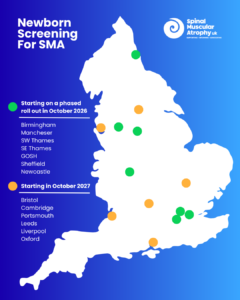 Landmark moment in the journey towards ensuring every baby born with spinal muscular atrophy (SMA) has the opportunity to receive life-changing treatment before symptoms develop.
Following confirmation, on the 16th July 2026, that newborn screening for SMA will begin across 72% of England from October 2026 as part of the NHS England in-service evaluation (ISE), we are delighted to welcome the news that the remaining six newborn screening laboratories will also begin screening from October 2027. This means that, within a year, every newborn baby in England will have access to screening for SMA, regardless of where they are born.
For future families affected by SMA, this is truly life-changing news. While this is a major milestone, our work is not yet done. We will continue working with partners in Wales and Northern Ireland to ensure every baby across the UK can benefit from newborn screening for SMA.
Section last updated: June 2026
We are delighted to announce that following discussions with the former Secretary of State, Wes Streeting we welcome the news that the ISE will begin screening for SMA in October 2026, significantly earlier than the previously expected timeline of January 2027.
However, newborn screening for SMA is currently only set to cover around 72% of babies in England starting on a phased roll out in October this year.
On the 22nd June 2026, the petition to add SMA to newborn screening in England was debated in Parliament. We are urging the Government to expand screening beyond a limited number of sites and ensure it is available across the whole of England.
You can watch the debate here.
Debate: 22nd June 2026
We have recently received an update from the Government confirming that the petition will be debated publicly on Monday 22 June in the second chamber of the House of Commons.
A key message we want to bring to that debate is the importance of expanding the screening pilot across the whole of England, rather than limiting it to the currently planned 70%. Early diagnosis is vital, and widening access to newborn screening would make a life-changing difference.
This is where your support can really make an impact. Find out how to get involved here
Government Statement
On Wednesday 21 January, the Department of Health and Social Care published the following statement:
“Jesy and other campaigners have made a powerful case for doing more on screening, and there is some good news on this. Planning for a large-scale trial across the NHS is underway, where hundreds of thousands of babies will be screened for SMA from next year to help build the evidence base needed to support a national screening programme. I have asked my team to look at whether this evaluation can start sooner, and whether it can be expanded to involve all babies, rather than two thirds as currently planned, and will be reporting back to the SMA community on this.”
Pivotal Media Attention
On Monday 20 January, ITVX invited our CEO, Giles Lomax, alongside Jesy, to meet with Wes Streeting. The 15-minute interview shown on This Morning built on Jesy’s appearance on the programme on 7 January.
In a 45-minute closed-door meeting between Giles, Jesy, and Wes Streeting, Giles presented a clear roadmap for newborn screening (NBS) for SMA for all babies in the UK. This outlined the actions the Secretary of State could take to accelerate progress.
Public Awareness Turning Point
On Sunday 5 January, Jesy Nelson, of Little Mix fame, shared publicly that her twins had been diagnosed with SMA Type 1. Since then, there has been significant media attention. This has increased public awareness of the condition and the urgent need for newborn screening. We are grateful to Jesy for speaking out and adding her voice to those of the families and individuals who live with the condition every day. For many, it echoed their own experiences of diagnosis and uncertainty. It showed beyond doubt that we need newborn screening for SMA across all the UK now.
Jesy’s Petition
On 6th February: Jesy launched a petition calling for faster action. Within 48 hours it had reached the threshold needed for a Parliamentary debate. It is still open for more signatures:
Review the evidence and fund the addition of SMA to the Newborn Screening Test >
SMA UK Actions
We are working hard to suggest ways to make progress faster. You can read about our latest endeavours in the next tab about the In Service Evaluation.
We are also very aware of the impact of all this media attention on the SMA Community and thank Luis Canto E Castro for writing about this in our guest blog:
When SMA hits the headlines: Holding space for parents and adults in our community >
Section last updated: 10th February 2026
The UK National Screening Committee (NSC) decides which conditions are included in the newborn bloodspot testing programme.
In June 2023, following many years of advocacy and campaigning by patient groups and clinicians, the UK NSC announced plans to run an In-Service Evaluation (ISE) of NBS for SMA. This is similar to a pilot study. The NSC sees this as a vital step towards making screening routine across the UK.
Initial Planning
in January 2024, clinicians, patient groups, NHS England and other experts were invited to join the NSC’s ISE/SMA Partnership to progress plans.
Since then, expert groups have been working on:
- how to get the NHS ready
- how to collect the evidence the NSC needs for a decision.
In August 2025, on behalf of UK NSC, the Sheffield Centre for Health and Related Research (ScHARR) developed a cost-effectiveness model to assess NBS for SMA compared with no screening.
Despite this strong evidence, and the existing international data, the UK NSC decided to proceed with the ISE and gather additional UK-specific data
In December 2025 NHS England’s ISE implementation group met.
The ISE has been designed in line with the National Institute of Health and Care Research (NIHR) research requirements. The decision about who will undertake the research should be made by the NIHR Technology funding committee in March 2026. There has been one application which they are reviewing.
The research proposal submitted for review has come from The University of Oxford working in partnership with SMA REACH UK, the University of Sheffield, the University of Warwick, King’s College London and SMA UK.
Read more about the preparation work for the ISE for SMA >
The ISE plan
The ISE aims to:
- screen a proportion of babies born in the UK for SMA
- gather UK-specific evidence on how screening works in practice
- test how quickly babies can move from a screening result to diagnosis and treatment
- inform the NSC’s final decision on whether SMA should be added to the national screening programme
Starting in January 2027 the ISE proposal will use seven existing newborn screening laboratories. These already have the required testing equipment.
The ISE has been planned with NHS England and are all in England:
- Manchester
- Sheffield
- South West Thames
- Great Ormond Street Hospital (GOSH)
- Newcastle
- South East Thames
- Birmingham
There would be a phased roll out so that by January 2028, these sites could screen approximately:
- 404,000 babies per year
- around 72% of babies
This leaves approximately:
- 163,000 babies per year without access to screening
- around 28% of babies.
These babies would potentially have to wait until 2030/31 for a UK NSC recommendation for routine NBS for SMA across all the UK.
We need a wider faster roll-out
Scotland has pushed ahead. They will add SMA to their newborn screening programme in early 2026. This will provide research and evaluation that will contribute to the ISE.
Across the UK, with a total of some 659,500 births in 2024, these plans leave these babies without screening for SMA:
- 27,000 babies per year in Wales
- 19,400 babies per year in Northern Ireland
- 163,000 babies per year in England
That’s a total of 209,400; approximately 32% of al babies per year in the UK without access to screening for SMA.
What Next?
NHS England will be instructed to support the seven screening sites to begin Verification and Validation (V&V) as soon as possible. This is required before screening can start.
SMA UK has highlighted the inequity of the ISE screening only 72% of babies in England. We have presented potential solutions to enable expansion to all babies. The Secretary of State has committed to working closely with us to explore these options.
SMA UK will continue to engage with the Welsh Government and Northern Ireland Assembly to ensure the devolved nations can implement screening as quickly as possible.
The Secretary of State will also review the process Scotland will use with their newborn screening for SMA programme .
In October 2018 the NSC decided not to add SMA to the newborn bloodspot testing programme. At this time there was just one disease-modifying treatment. One of the reasons for the decision was that, at that time, there was no evidence of its effectiveness in children without symptoms.
By 2020 the treatment landscape had started to change. Clinicians and patient groups formed the Newborn Screening Alliance.
Funding for the Alliance ended in early 2025 but clinicians and patient groups continued to campaign and advocate at every possible opportunity.
Letter to the Lancet
On 7 February 2025, the frustrations of all were set out by leading SMA clinicians. Their powerful letter, published in the world-leading medical journal The Lancet, presented a stark message:
- babies with SMA type 1 in the UK are still dying
- those who survive cannot walk
- many rely on ventilatory support and tube feeding
By contrast, in countries such as Belgium, where babies are diagnosed through newborn screening and treated early:
- all babies survive
- all are able to walk
- none rely on ventilatory or nutritional support
This is not because treatments are different, it is because timing is different. For SMA, early diagnosis saves motor neurons that cannot be replaced. Once symptoms appear, damage has already been done.
Worldwide Evidence and Action
The ‘real-world’ research paper published on 8th April 2024 also confirmed the Clinical Effectiveness of Newborn Screening for SMA >.
SMA UK, alongside clinicians and partners, continues to do everything possible to have SMA added to the bloodspot test. We continue to:
- advocate for the earliest possible start to screening
- push for the fastest possible treatment pathways
- ensure that information developed for parents is clear, sensitive, and supportive
- represent the urgent needs of babies and families affected by SMA
We will keep pushing, keep advocating, and keep families informed every step of the way.
Last updated: December 2025
Ollie
 SMA UK worked closely in collaboration with Havas Life London, to produce a short film emphasising the urgent need for Spinal Muscular Atrophy (SMA) to be included to the UK Newborn Screening (NBS) programme.
Watch this emotive short film where 4-year-old Ollie shares the things he’ll never get to do because SMA wasn’t included in the newborn screening test when he was born. SMA is rare and irreversible, but early diagnosis and treatment can change everything.
Amelia
My name is Amelia. I am 16 years old and I have had SMA type 2 all my life. My sister Lena has SMA too, but she was diagnosed at birth and has had a gene therapy which hopefully will prevent the progression of the disease.
Portia and Ezra
Portia’s son, Ezra has SMA type 1. Their journey highlights the importance of new born screening and how it could transform the lives of those living with SMA in the future. This short film, made when Ezra was aged 5 years, was part of Rare Disease Day 2022 when Genetic Alliance UK partnered with ITN to produce ‘Shining a Light on Rare Conditions’, a news-style programme raising awareness of people affected by rare, genetic, and undiagnosed conditions.
Eden
Eden, who has SMA Type 3, and her mum describe more about how the condition affects Eden, their experience of diagnosis, and how newborn screening could change the lives of others like theirs:
Teddy
Neil talks about the short time his family had with their son Teddy who had SMA Type 1, and why he supports pre-symptomatic screening and treatment for SMA.
Ollie
Ben describes his family’s journey to diagnosis and treatment for son Ollie who has SMA Type 1 and the difference pre-symptomatic screening and treatment would make.
NHS-funded newborn bloodspot testing for SMA has now started in Scotland. Testing elsewhere in the UK is currently only possible in very limited circumstances during pregnancy and when a baby is born. We outline what these are and discuss private testing for 5q SMA.
News stories highlighting the need for newborn screening for SMA.
The clinicians who wrote to The Lancet described the “human toll of slow decisions”. Families living with SMA know exactly what that means.
Newborn screening for SMA will only become a reality in the UK if momentum is maintained and decision-makers understand just how urgent this is for families.
Sign Jesy’s Petition
Our heartfelt thanks to Jesy for setting up her petition calling for SMA to be added to the UK newborn screening heel-prick test. It has has now reached over 148,000 signatures, This means Parliament will consider it for a debate.
But please keep up the pressure and add your signature Early diagnosis can be life-changing. This campaign has the power to make a real difference for families across the UK.
Every voice truly matters.
Read, share and sign the petition here.
Write to your local MP
To keep the pressure on the government, it’s vital that the SMA community now writes to their local MP, asking them to attend the debate when a date is scheduled and to support expanded newborn screening.
With the current in-service evaluation only planning to screen 72% of England, future diagnosis could be dictated by where a baby is born. This postcode lottery is unacceptable. We are urging the government to expand screening so that all babies are screened, giving every child the best possible start.
Writing to your MP is quick and easy, and just a few minutes of your time can make a powerful difference.
How to write to your MP:
1. Download and open our template letter:
You can download the template here.
2. Edit the letter with your own details
Add your name, address, and any personal comments you’d like to include. Personalising your message makes it even more impactful.
3. Find your local MP:
Find your local MP here by entering your postcode.
4. Select your MP, paste in your amended letter, and hit send.
That’s it! In just a few minutes, you can help ensure this issue stays firmly on the government’s agenda.
Thank you for standing with the SMA community.
Further Information
The SMA Spotlight: A Lesson for the UK
SMA has received much media attention and has been making waves in the political landscape. We’ve seen heartbreaking and hopeful stories of delayed access to life-changing gene therapies. While the spotlight on SMA is vital, it serves as a glaring example of a systemic failure: we are reacting to crises rather than preventing them.
The current spotlight must be a catalyst for the UK to realise that SMA is just the tip of the iceberg. There are hundreds of other treatable rare conditions, like MLD (Metachromatic Leukodystrophy ) or ALD (Adrenoleukodystrophy), where early detection is the difference between a healthy life and a devastating terminal prognosis.
Why the NSC System is No Longer Fit for Purpose
The National Screening Committee (NSC) is the gatekeeper of the heel prick test. However, as highlighted in the Genetic Alliance report, Newborn Screening for Rare Diseases (see below, the current criteria used to evaluate new tests are outdated.
The Problems with the Current System:
- The Effective Treatment Trap: The NSC often requires proof of a treatment’s effectiveness in a UK setting before screening is approved. But without screening, you can’t identify the pre-symptomatic babies needed to prove the treatment works. It’s a deadly Catch-22.
- Lack of Agility: While countries like the USA and Italy screen for over 40 conditions, the UK screens for just ten. Our rigid adherence to traditional evidence models is causing us to fall behind internationally.
- Inflexible Evidence Models: Rare diseases don’t have the luxury of large-scale clinical trials. The NSC needs to adopt a more pragmatic approach that weighs the cost of inaction against the rigor of data.
Genetic Alliance UK’s July 2025 policy report on newborn screening for genetic and rare conditions
Expanding population screening for genetic and rare conditions is a key part of Genetic Alliance’s five-year strategy. While many countries now screen for over 20 conditions, only nine conditions are included in the UK’s NHS Newborn Blood Spot Screening Programme. There is growing consensus from across the rare community and Genetic Alliance UK’s broader network of stakeholders that this needs to change.
The report explores how the UK National Screening Committee (UK NSC) can accelerate its approach to decision-making for expanding newborn screening, drawing on research findings from 14 countries to identify practical, evidence-informed steps for improving the way decisions are made in the UK. It also considers the role of genomic newborn screening.
The report calls on governments and health system leaders to:
- adopt a pragmatic approach to evaluating evidence for genetic and rare conditions
- strengthen the involvement of patient organisations in decision-making
- ensure greater transparency in decision-making
- introduce more agile review processes to promote readiness for new screening technologies, including whole genome sequencing
- commit to a long-term plan for broader health systems innovation, including readiness for new therapies.