Our thoughts are with Jesy, Zion and their family following the news that their twin daughters have been diagnosed with spinal muscular atrophy (SMA).
We know this is an incredibly difficult time, and we’re grateful to them for sharing their story so openly with the aim of helping to raise awareness of the urgent need for SMA to be diagnosed as early as possible through newborn screening.
SMA is a rare, neuromuscular condition. It causes progressive muscle wasting (atrophy) and weakness. It may affect crawling and walking ability, arm, hand, head and neck movement, breathing and swallowing. How severely people are affected, and in what way, varies greatly. Without early diagnosis and treatment, babies with the most severe forms of SMA can experience rapid and irreversible muscle weakness, leading to serious disability and, in some cases, life-threatening complications.
Today, we have effective treatments for SMA. But timing is everything. The evidence is clear: babies who are diagnosed and treated before symptoms appear have significantly better health outcomes. Many can meet developmental milestones that would not have been possible without early intervention. Once symptoms begin, damage to motor neurons cannot be undone.
This is why newborn screening is so important. Screening allows SMA to be identified in the first weeks of life, often before any signs are visible, giving families and clinicians the opportunity to act quickly, start treatment early, and give babies the best possible chance to thrive.
Despite this, SMA is not yet screened for at birth across the UK. Too many families still face a diagnostic delay, often after weeks or months of uncertainty, hospital visits, and the onset of symptoms that could have been prevented.
At SMA UK, we believe every baby deserves the best possible start in life. We are working tirelessly to push for the introduction of SMA into the UK’s newborn screening programme by:
- Advocating to policymakers, clinicians and screening bodies using the strongest available clinical and economic evidence.
- Amplifying the voices and lived experiences of families affected by SMA
- Collaborating with researchers, healthcare professionals and partner organisations to demonstrate the life-changing impact of early diagnosis
- Raising public awareness so that newborn screening for SMA becomes a clear and urgent priority
Newborn screening has the power to prevent and reduce long-term healthcare needs, and transform outcomes for babies and families across the UK.
Cost-effectiveness of Newborn Screening in the UK
In August 2025, A cost-effectiveness model was developed by the Sheffield Centre for Health and Related Research (ScHARR) on behalf of the UK National Screening Committee who decide whether SMA is included on the heel prick test.
Their model which assessed screening versus no screening, found significant potential benefits and cost savings across the UK.
Every year screening for SMA will:
- Prevent 2 babies requiring permanent ventilation
- Prevent around 3 children from early deaths
- Prevent 30 babies from being confined to a ‘sitting state’
- And enable 37 babies to live a largely normal life.
According to their modelling it will save the NHS £5.7million per year which doesn’t include the wider social and caregiver costs.
All the analyses have suggested that implementing screening could result in better outcomes and lower costs compared to the current approach of no screening plus treatment.
Signs and Symptoms of SMA
The signs and symptoms of spinal muscular atrophy (SMA) can vary depending on the type, but often include muscle weakness, low muscle tone (floppiness), and delays in reaching movement milestones such as sitting, crawling or walking. In babies, this may show as difficulty lifting the head, feeding or swallowing problems, and shallow or laboured breathing. SMA is commonly described in types, ranging from more severe forms that present in infancy to later-onset types that appear in childhood or adulthood. SMA is a progressive condition, meaning symptoms can worsen over time, which is why early recognition and diagnosis are so important.
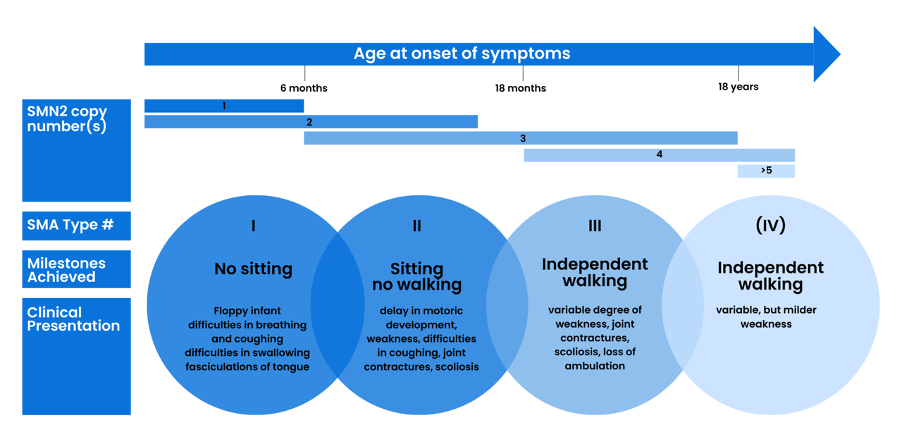
Clinical classification of SMA subtypes according to onset, milestones achieved, and clinical presentation. Typically associated SMN2 copy numbers are shown. Figure taken with permission from Schorling D et al. (2019) Advances in Treatment of Spinal Muscular Atrophy – New Phenotypes, New Challenges, New Implications for Care J Neuromuscul Dis 7: 1-13, under the CC BY-NC 4.0 licence.
If you are concerned about your baby’s development, please visit your GP.
No family should face the devastating consequences of a late diagnosis when early detection is possible. SMA UK will continue to campaign for change until every baby born in the UK has access to newborn screening for SMA and the chance of a healthier future from the very beginning.
SMA UK offer practical and emotional support and accredited health information to all those affected by SMA.